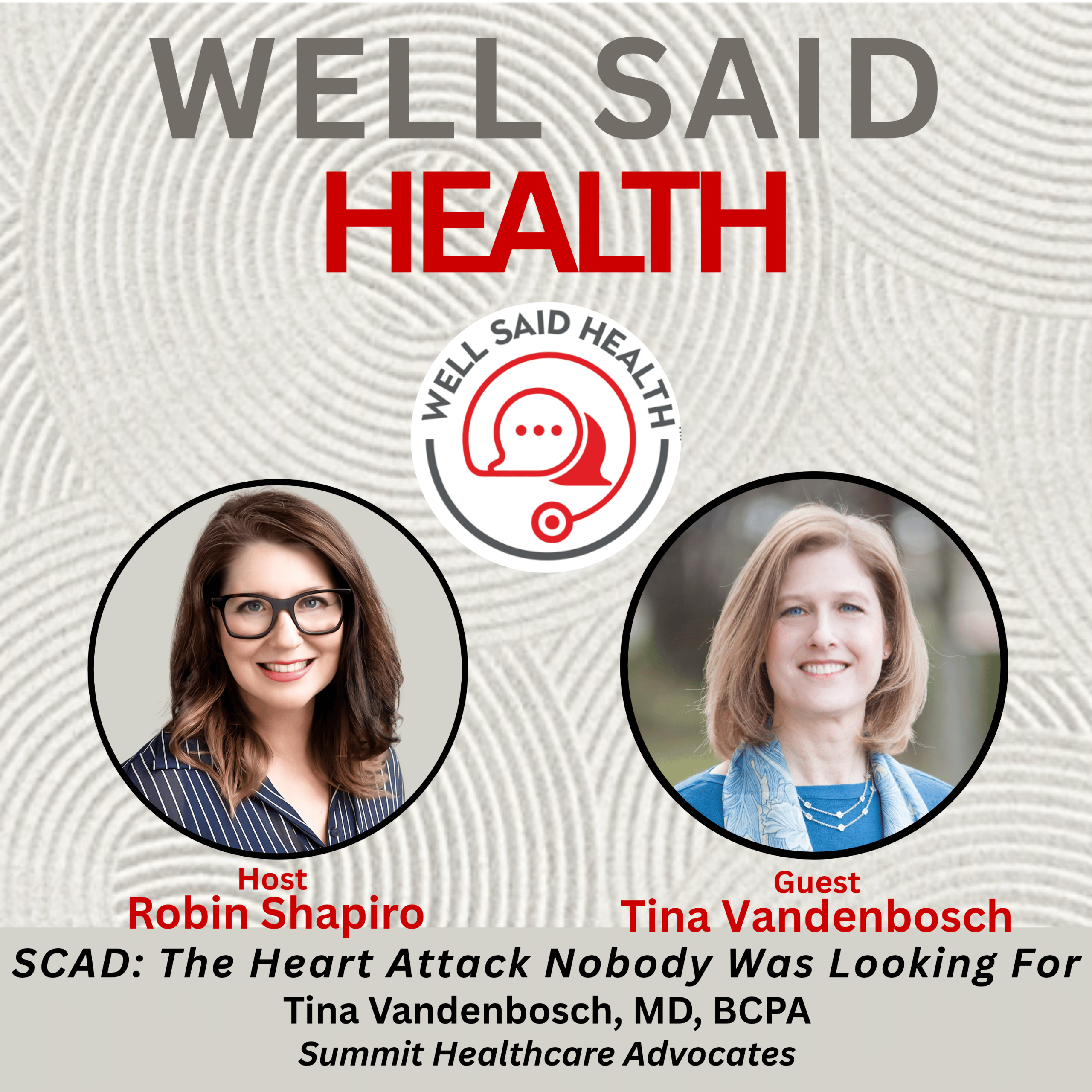
SCAD: The Heart Attack Nobody Was Looking For
SCAD: The Heart Attack Nobody Was Looking For
Tina Vandenbosch, MD, BCPA — Summit Healthcare Advocates
Well Said Health with Robin L. Shapiro
Listen on



Show Notes
She was a physician, a professional patient advocate, and in the middle of a heart attack — and she still told her husband she was being a hypochondriac.
Dr. Tina Vandenbosch had a SCAD heart attack on a three-mile jog, six weeks after COVID and one week before a triathlon. Spontaneous coronary artery dissection (SCAD) is the leading cause of heart attack in women under 50 and in pregnancy — a tear in a coronary artery with no plaque, no cholesterol, no clogged artery. It strikes healthy, active women with no risk factors, and 41% of cases are missed the first time.
Tina walks through what a heart attack actually feels like in a woman — armpit pressure, jaw pain, fatigue, something like acid reflux — why a normal EKG doesn't rule it out, and the one blood test to ask for by name. Robin closes with the exact words to say in an emergency room.
Hosted by Robin Shapiro, author of The Secret Language of Healthcare.
Download complete Show Notes in PDF format.
00:00:00.000 --> 00:00:10.000
Robin Shapiro: Welcome to Well Said Health. I'm Robin Shapiro.
00:00:10.000 --> 00:00:30.000
Robin Shapiro: Every episode, we take one healthcare situation where the right words can change everything, and we give you the language to handle it. A woman is in her car with her husband on the way to urgent care. She's been having pressure under both arms and a tightness in her throat, and halfway across the bridge, the pain eases up.
00:00:30.000 --> 00:00:55.000
Robin Shapiro: So she turns to him and says, "Let's go home. I'm fine. I think I'm a hypochondriac." She was, at that moment, in the middle of a heart attack. She was also a physician and a professional patient advocate, which is exactly why I wanted you to hear this story. Today, we're talking about SCAD, spontaneous coronary artery dissection.
00:00:55.000 --> 00:01:24.000
Robin Shapiro: It's a heart attack, but not the kind you're picturing. There's no plaque, no cholesterol, no clogged artery. It's a tear in the wall of one of the arteries feeding your heart, and it happens to people who look nothing like a heart patient. Here's why this should be on your radar. SCAD causes up to a third of heart attacks in women under 50 and under, and about nine out of 10 people are women who get it, often in their 30s, 40s, and 50s.
00:01:24.000 --> 00:01:50.000
Robin Shapiro: And most of them have no risk factors at all, no high blood pressure, no diabetes, normal cholesterol. It's also the most common cause of heart attack in pregnancy, and it gets missed. One study found that 41% of SCAD cases were not correctly identified the first time around When a healthy-looking woman walks into an emergency room, the first question is often, "Are you stressed?"
00:01:50.000 --> 00:02:19.000
Robin Shapiro: or, "Could this be anxiety?" Now, I want to be clear about something. Plaque, the ordinary kind of heart disease driven by smoking, blood pressure, diabetes, cholesterol, is still the biggest driver of heart disease in women overall. This episode isn't telling you prevention doesn't matter. It's telling you that being fit, young, low risk does not rule out a heart attack, and that more women die of cardiovascular disease than all cancers combined.
00:02:19.000 --> 00:02:47.000
Robin Shapiro: Your words matter, and that's what this show is about. This podcast is not medical advice. I'm not a doctor. What we do here is give you insight, education, and the specific words to ask for the care you deserve. My guest today is Dr. Tina Vandenbosch, a board-certified family physician, retired from active clinical practice, and the founder of Summit Healthcare Advocates here in the Seattle area.
00:02:47.000 --> 00:03:17.000
Robin Shapiro: She spent 17 years as a family doctor. She now advocates for patients professionally. And in September of 2021, six weeks after a bout of COVID and one week before a triathlon she was training for, she had a SCAD heart attack on a three-mile jog. She's going to tell you about the two separate times she talked herself out of getting help, and she'll give you the exact words to say in the emergency room, plus one blood test whose name you're going to want to write down.
00:03:17.000 --> 00:03:24.000
Robin Shapiro: Here's my conversation with Dr. Tina Vandenbosch. Tina, welcome to Well Said Health.
00:03:24.000 --> 00:03:27.000
Tina Vandenbosch: Thank you. Happy to be here.
00:03:27.000 --> 00:03:37.000
Robin Shapiro: So you were a family physician for seventeen years, then you left clinical practice to become a patient advocate. What did you see coming in that time?
00:03:37.000 --> 00:03:54.000
Tina Vandenbosch: Over the course of my years of practice, I saw an increasingly fragmented health system where the role of the family physician, primary care, was gradually being hollowed out from the inside.
00:03:54.000 --> 00:04:30.000
Tina Vandenbosch: Early on in my career, it really appealed to me to be the quarterback for my patients. Over the years, with shrinking appointment time slots down to fifteen minutes, sometimes ten, administration hassles, headaches, talking with insurance companies, it became clear that the math simply didn't work. You cannot safely compress complex human issues into such small fragments of time.
00:04:30.000 --> 00:04:57.000
Tina Vandenbosch: And over the recent years, as we've all witnessed, there's a lot more referrals to specialists. Patients are broken down into organ systems. And it's great to get good specialist care, but the problem is our care has become so incredibly siloed that there isn't any one person that truly integrates the whole picture for the patient.
00:04:57.000 --> 00:05:12.000
Robin Shapiro: So I wanna switch gears and go into really the heart of this episode. Take me back to September twenty twenty-one when your dad got COVID. What was going on in your life during that month?
00:05:12.000 --> 00:05:29.000
Tina Vandenbosch: Yeah. He had been hospitalized with COVID about six weeks prior, very late July. I went to live with him to take care of him and keep my mom sequestered, knowing that I was likely going to get COVID.
00:05:29.000 --> 00:06:01.000
Tina Vandenbosch: And this was after vaccinations. I had been vaccinated, but of course, I got it, and I was down for a good week. Seemed to bounce back. And late August, I kind of jumped back in. I was training for a triathlon for s- early September And so I was tapering down and getting ready for this triathlon and, went on an easy jog just to kinda loosen up.
00:06:01.000 --> 00:06:44.000
Tina Vandenbosch: I was going along my merry way and I started feeling some tightness in my neck, both the back of the neck and around in the front. And it felt a little odd, but you know, I chalked it up to some bicycling the day before, hunched over, and I was thinking, "Ugh, this is probably musculoskeletal, no big deal And then I started experiencing tightness under both armpits, and it was, not a tight squeeze, but just a sensation like someone had their hands under my armpits and they were trying to lift me up in the air.
00:06:44.000 --> 00:07:18.000
Tina Vandenbosch: So it was all very strange, and I stopped running, stretched, thinking, "This is, whatever it is, this is nothing." And then as time went on, I started thinking, "All right. Hmm. Could this be something worrisome?" Because I've never experienced this before. And the thought of this being cardiac in origin bubbled up to the surface, but I instantly denied that thought because I don't have any risk factors for heart disease.
00:07:18.000 --> 00:07:57.000
Tina Vandenbosch: There's no way I could have a heart issue. And, the other thought I had was because I had had COVID six weeks prior, people with COVID, they're more prone to blood clot formation because of inflammation, and I thought, "Well, maybe, could I have a pulmonary embolism, a clot in my lungs?" And then I denied that, and my symptoms started getting a little bit better, and I thought, "Who knows what this is, but I'm feeling a little bit better," and I jogged home.
00:07:57.000 --> 00:08:18.000
Tina Vandenbosch: And, by then symptoms had a- abated, and, went inside. My husband was home, but I didn't even think to tell him about what had just happened because it was already behind me. I jogged up my stairs, a few flights of stairs, and symptoms all returned with-
00:08:18.000 --> 00:08:22.000
Robin Shapiro: Oh, gosh ...
Tina Vandenbosch: a vengeance, especially in, in the neck.
00:08:22.000 --> 00:08:24.000
Robin Shapiro: So what did that feel like?
00:08:24.000 --> 00:08:28.000
Robin Shapiro: Did it feel like, somebody pressing on your neck, or what did that feel
00:08:28.000 --> 00:08:34.000
Tina Vandenbosch: like? It, it felt like a tightness. Like- Mm. Mm-hmm ... I'd lost some range of motion of my neck.
00:08:34.000 --> 00:08:36.000
Robin Shapiro: Mm, mm, mm-hmm.
00:08:36.000 --> 00:08:54.000
Tina Vandenbosch: So, anyway- Scary ... I took my own blood pressure. I have a blood pressure cuff up there that I use for my parents, my elderly parents, and checked it, and I have never had a history of high blood pressure, and my blood pressure was sky high.
00:08:54.000 --> 00:09:15.000
Robin Shapiro: Oh ...
Tina Vandenbosch: so at that point, I had objective evidence that something is going on, and, went downstairs and Told Dave, I'm not feeling so hot. Can you drive me to urgent care?" And when I told him what was going on, he's like, "Oh, yeah."
00:09:15.000 --> 00:09:30.000
Robin Shapiro: So Tina, one of the most compelling things I, I think about this story is you're, you've been a family physician, you've been an advocate, you're having these symptoms, you're dismissing, dismissing, dismissing.
00:09:30.000 --> 00:09:44.000
Robin Shapiro: You even have the blood pressure cuff, which I think most people don't have. Tell me about what you were thinking and what happened in the car ride over when your husba- h- husband was taking you to urgent care.
00:09:44.000 --> 00:10:00.000
Tina Vandenbosch: Yeah. The, the, the denial continued. I was, I was relieved he was home, and he could drive me to urgent care when I had the recurrent symptoms again, and I certainly didn't wanna call 911.
00:10:00.000 --> 00:10:32.000
Tina Vandenbosch: And so, we get in the car, and as we're driving over the I-90 bridge, my symptoms started to subside again. We were about halfway there, and my my response was, "Oh, you know what? I, I think I'm a hypochondriac," or, "The urgent care folks are gonna think I'm a hypochondriac because, Dave, my symptoms are better, and I don't wanna walk in there and waste their time."
00:10:32.000 --> 00:10:36.000
Robin Shapiro: But what did your husband say?
00:10:36.000 --> 00:10:54.000
Tina Vandenbosch: He said, "Nope. Nope, we're going." He was concerned, and, he's, he's seen a past history from me of denying physical symptoms. So thank goodness we pressed onward and, and arrived.
00:10:54.000 --> 00:11:12.000
Robin Shapiro: And you were having a heart attack, right, during all of that. It's- Yes ... it's amazing. And I think, for anyone out there who you know, has ever diminished a symptom, and I think we all probably have done that, this is a very good lesson.
00:11:12.000 --> 00:11:17.000
Robin Shapiro: So you got to urgent care. What did you look like when you were walking in?
00:11:17.000 --> 00:11:38.000
Tina Vandenbosch: I looked like healthy, pretty healthy 56-year-old. I was not short of breath. I probably had a smile on my face. Looked like I was probably bringing someone else into the ER that day. I wasn't short of breath, not dizzy. Looked pretty normal.
00:11:38.000 --> 00:12:09.000
Tina Vandenbosch: And, so the receptionist probably thought, "Oh, here comes the worried well, someone that really doesn't have anything wrong with them, but-" is nervous, a nervous Millie. I explained to the triage nurse, who was excellent, she had all the right questions, the symptoms that I had had, and, and I was really clear to say, "But no chest pain And I'm feeling pretty normal now.
00:12:09.000 --> 00:12:44.000
Tina Vandenbosch: I think this is what women do. downplayed. We don't wanna inconvenience the healthcare staff with something that might not be serious, right? But I shared my symptoms, and she laid me down, immediately did an EKG. I was really glad she did. The EKG clearly showed... It's an electrical reading of your heart, and, if there are parts of the heart that aren't getting oxygen, you can see it on an EKG.
00:12:44.000 --> 00:13:00.000
Tina Vandenbosch: And, I had very clear-cut signs that I was in the midst of a heart attack. And some people might have a normal E- EKG, but still be having a heart attack. I was lucky that it was so obvious.
00:13:00.000 --> 00:13:05.000
Robin Shapiro: What did your brain do when you saw that it was so clear? Like, what were you
00:13:05.000 --> 00:13:08.000
Tina Vandenbosch: thinking? Yeah. I asked to look at it.
00:13:08.000 --> 00:13:11.000
Tina Vandenbosch: She puts it in front of me, and I'm like, "Wait- Trust
00:13:11.000 --> 00:13:12.000
Robin Shapiro: but verify. "...
00:13:12.000 --> 00:13:33.000
Tina Vandenbosch: are you sure this is mine?" and I'm looking at the name on the label. "Are you sure?" And, anyway, they immediately got me back and called the hospital next door and rolled me underground through a tunnel to the adjacent hospital under the freeway, and I was really lucky.
00:13:33.000 --> 00:13:37.000
Tina Vandenbosch: Lucky I live in an urban area with immediate care.
00:13:37.000 --> 00:13:45.000
Robin Shapiro: Yeah, because if you had been in an urgent care not connected to a hospital, what could've happened?
00:13:45.000 --> 00:14:00.000
Tina Vandenbosch: Yeah. Well, every second when you're having a heart attack, there is an obstruction somewhere in the arterial supply to your heart, and that part of the heart's not getting oxygen.
00:14:00.000 --> 00:14:15.000
Tina Vandenbosch: And in cardiology, the phrase is, "Time is muscle." So the longer you're depriving your heart muscle of oxygen, the muscle is dying. You're losing part of the muscle.
00:14:15.000 --> 00:14:33.000
Robin Shapiro: Well, that seems very scary. And, we know in our country how devastating heart disease is and heart attacks and strokes are, but the kind of heart attack that you had is very unknown.
00:14:33.000 --> 00:14:42.000
Robin Shapiro: Like, people probably haven't heard of the type of heart attack that you had. So can you tell us a little bit about what SCAD is?
00:14:42.000 --> 00:15:06.000
Tina Vandenbosch: Sure. Yeah. So, SCAD is an acronym for a type of heart attack. It's called spontaneous coronary artery dissection. And a dissection is a tear within the artery. So in my case, one of my arteries tore a little bit.
00:15:06.000 --> 00:15:35.000
Tina Vandenbosch: And a way to picture what a dissection is, is if you think of an artery as having several layers, it does have several layers, and if there is a little tear in one of the layers, the blood flow through that artery can track into the t- the torn area outside of the hose passageway where your blood is pumping through.
00:15:35.000 --> 00:16:15.000
Tina Vandenbosch: And as you get blood tracking improperly into the torn area That can clot inside that torn area and then compress down on the artery and effectively cause an obstruction. So it's almost like a bruise or a hematoma that forms on the inside of the blood vessel. The interventional radiologist that did my angiogram has seen a lot of SCAD and was suspicious that it was SCAD, and so immediately removed the catheter from the heart.
00:16:15.000 --> 00:16:25.000
Tina Vandenbosch: The best thing to do is remove the catheter because you don't want to disrupt that dissection, and-
00:16:25.000 --> 00:16:27.000
Robin Shapiro: The tear, 'cause it could tear it more,
00:16:27.000 --> 00:16:28.000
Tina Vandenbosch: right- It could tear it more ... I'm
Robin Shapiro: imagining.
00:16:28.000 --> 00:16:51.000
Tina Vandenbosch: Absolutely. Yeah. Scary. Well, in a traditional heart attack, which is much more common, as I mentioned before, a stent is often in- introduced to that part of the vessel to act as a scaffolding to help, help hold that artery open, and that's the last thing you want to do in SCAD because it can worsen the tear.
00:16:51.000 --> 00:17:19.000
Tina Vandenbosch: And so basically they stop the angiogram, and, they hospitalize and monitor, and, the good news is if you catch this early enough, a lot of SCADs will heal on their own. So I did not have any intervention. There are medications that are given to lower the heart rate, and aspirin, and there...
00:17:19.000 --> 00:17:25.000
Tina Vandenbosch: a period of time where you have to really take it easy. I was a couch potato for a while.
00:17:25.000 --> 00:17:52.000
Robin Shapiro: So what would have happened if you had not had an astute interventionalist cardiologist, interventional cardiologist? Like, what happens with SCAD? Like, are there a lot of deaths around, or deaths or injury around misdiagnosis or different treatment or maybe not removing the catheter out fast enough, like-
00:17:52.000 --> 00:17:53.000
Tina Vandenbosch: Yeah.
00:17:53.000 --> 00:18:28.000
Tina Vandenbosch: M- No, the biggest reason for death with SCAD, and SCAD is, happens in, like, 95% of women only. It does occur in men, but more often women, and the biggest reason for death in SCAD is delayed diagnosis For women or any, or men, if you do get care immediately and it's diagnosed, the healing rate, survival rate is very high, 90%.
00:18:28.000 --> 00:18:29.000
Robin Shapiro: That's the good
00:18:29.000 --> 00:18:31.000
Tina Vandenbosch: news. That is the good news. That is the good
00:18:31.000 --> 00:18:54.000
Robin Shapiro: news. Yeah. In one study, there's a 41% incidence of missed diagnosis of SCAD. So it's huge percentage of it not being caught or diagnosed, and it's- What happens to the heart muscle when someone is talking themselves out of going in and being seen?
00:18:54.000 --> 00:19:17.000
Tina Vandenbosch: Yeah. The longer we wait, if there is an obstruction in one of the arteries to the heart, that area of the heart receives oxygenated blood from that vessel, gets starved of oxygen. And over time, those myocardial heart muscle cells start dying.
00:19:17.000 --> 00:19:18.000
Robin Shapiro: That sounds bad.
00:19:18.000 --> 00:19:25.000
Tina Vandenbosch: It's bad. Yeah. And as you lose more and more heart muscle, it doesn't come back.
00:19:25.000 --> 00:19:44.000
Tina Vandenbosch: And when someone has had a heart attack, the medical term is a myocardial infarction. Myocardium is, is a name for the heart muscle, and infarction means death. So basically, you're killing off some of your muscle pump tissue
00:19:44.000 --> 00:20:00.000
Robin Shapiro: Which is why it is so important to not talk yourself out of getting help. I, I have a friend and a neighbor, this just happened two weeks ago, who called me and she said, "I really don't feel well."
00:20:00.000 --> 00:20:23.000
Robin Shapiro: And she was breathing heavily, and she said, "I, I'm nauseous. I have pain under my breast bone. I'm having trouble breathing." And I said, "Hang up and call 911. You are likely having a heart attack." And she said, "Oh, no, no." And I said, "Yes, yes, you actually need to hang up and call 911 right away."
00:20:23.000 --> 00:20:24.000
Tina Vandenbosch: You-
00:20:24.000 --> 00:20:25.000
Robin Shapiro: And she said-
Robin Shapiro: right on.
00:20:25.000 --> 00:20:27.000
Tina Vandenbosch: That was-
00:20:27.000 --> 00:20:35.000
Robin Shapiro: And, but, but she said, "Oh, no, no. I, I can't go in an ambulance, my back," and this and that and the other. And I live, like, two minutes from her.
00:20:35.000 --> 00:20:48.000
Tina Vandenbosch: Mm-hmm.
Robin Shapiro: So I went over, and on my way, we did this episode with the hospitalist, Dr. Clark Kohler, it was episode two. And I called him and I said, "So these are my friend's symptoms.
00:20:48.000 --> 00:21:02.000
Robin Shapiro: Which of the hospitals should I be taking her to?" 'Cause we have several in Seattle, and I thought he would know because he works at most of them. And he said, "Does your friend know how selfish she is being?"
00:21:02.000 --> 00:21:03.000
Tina Vandenbosch: Uh-huh.
00:21:03.000 --> 00:21:16.000
Robin Shapiro: And I said, "I don't think so. I don't think she's thinking clearly." So anyway, we, we got there, and I'm, I'm so glad we went, and it ended up not being a heart attack.
00:21:16.000 --> 00:21:24.000
Robin Shapiro: But, but the symptoms were just, like, classic symptoms for women our age.
00:21:24.000 --> 00:21:25.000
Tina Vandenbosch: Right.
Robin Shapiro: So.
00:21:25.000 --> 00:21:31.000
Tina Vandenbosch: Right.
Robin Shapiro: Anyway.
Tina Vandenbosch: Well, you did exactly the right thing. Ideally, she would have called 911.
00:21:31.000 --> 00:21:39.000
Robin Shapiro: I explained to her if she were having a heart attack and she was in my car, I couldn't have done anything for her, Yeah. So.
00:21:39.000 --> 00:22:18.000
Tina Vandenbosch: Yep. Very traumatizing to witness that. And, and I did the same thing to my poor husband. I, I could have just gone flat into cardiac arrest, because I was denying. So it is kind of selfish. And women, this is why cardiovascular disease is the number one killer in women, because we totally underestimate our risk of having a heart attack, and we talk ourselves out of our symptoms.
00:22:18.000 --> 00:22:26.000
Tina Vandenbosch: oh, I don't have time. Ugh, it'll go away. Ugh, it's just heartburn.
00:22:26.000 --> 00:22:44.000
Robin Shapiro: So SCAD i- in particular happens primarily overwhelmingly to women, younger women too. So do we know why this happens? Like, why these particular types of SCAD heart attacks happen, and why in women?
00:22:44.000 --> 00:22:59.000
Tina Vandenbosch: Yeah. Yeah. Well, there's still a lot of questions without answers, but there's more and more attention being paid towards SCAD, and more studies going on, and so we will hopefully keep learning more.
00:22:59.000 --> 00:23:28.000
Tina Vandenbosch: So we think presently that there's a few risk factors, and it tends to be younger women that have SCAD. We think that hormones play a part, especially in pregnancy. We do see SCAD heart attacks occurring during pregnancy and postpartum in women. Obstetricians will know about SCAD. It's not super common, but they see it.
00:23:28.000 --> 00:23:56.000
Tina Vandenbosch: And, and again, it's tricky because when you see a young healthy woman, the last thing you think about is a heart attack, especially, a, a large number of women that have SCAD heart attacks do not have risk factors, the traditional risk factors of hypertension, hyperlipidemia, diabetes. We think hormones plays a part.
00:23:56.000 --> 00:24:39.000
Tina Vandenbosch: A fair portion of women that have SCAD have something called fibromuscular dysplasia, FMD. It's strongly associated with SCAD, and basically FMD is an abnormality of arterial walls in our vessels, and it can cause weakness. The blood vessel walls develop areas of narrowing or enlargement, so it raises the risk of a dissection or tear, and it also increases the risk of aneurysms So that, that is strongly associated with it.
00:24:39.000 --> 00:25:15.000
Tina Vandenbosch: The thought, a commonality on women that have SCAD is some of them are doing extreme exercise or endurance activities, ultramarathons, heavy weight lifting. So there's thought that that might have something to do with it, and it may be that a woman is just more prone to having a tear, and then when they're doing this heavy-duty physical activity, that might just be the high heart rate and the adrenaline surge that causes the incident.
00:25:15.000 --> 00:25:22.000
Robin Shapiro: So if somebody has had a SCAD heart attack, what should be checked afterward?
00:25:22.000 --> 00:25:52.000
Tina Vandenbosch: So once you've been diagnosed with SCAD and out of the hospital, part of the workup that is done is a head to pelvis CT scan, and that is done to screen all of your vessels, brain, neck, the carotid vessels, and kidney arteries, and the other arteries in your abdomen for signs of fibromuscular dysplasia.
00:25:52.000 --> 00:26:25.000
Tina Vandenbosch: And they're looking to see if there are any aneurysms or sometimes the, with fibromuscular dysplasia, given the weakness in the arteries, you'll see a kind of a beaded string appearance of vessels because they kind of balloon out and almost looks like a string of beads. And so that screening is done. If a person has it, they are at greater risk for recurrent SCAD and aneurysms.
00:26:25.000 --> 00:26:28.000
Robin Shapiro: So you definitely want to get that checked.
00:26:28.000 --> 00:26:50.000
Tina Vandenbosch: Absolutely. There is a lot of genetic testing going on now. Mayo Clinic in Rochester, there's a woman cardiologist there, Dr. Sharon Hayes, who started seeing more women with SCAD and realized, wow, there's probably more of this out there, and we are just not diagnosing it.
00:26:50.000 --> 00:27:05.000
Tina Vandenbosch: And so she's developed quite a registry of SCAD patients, and they're doing genetic testing to try to figure out if there is a genetic link. Right now, it doesn't look like it.
00:27:05.000 --> 00:27:18.000
Robin Shapiro: So one of the things that we do at Well Said Health Podcast is provide a toolkit. So that's basically advice or suggestions about what to look for.
00:27:18.000 --> 00:27:27.000
Robin Shapiro: So tell me how women's heart attack symptoms actually present because it's not the typical elephant on the chest.
00:27:27.000 --> 00:27:57.000
Tina Vandenbosch: That it, yes, that is a really important point. In women, I mean, women might very well present with the stereo- stereotypical elephant on the chest, lightheadedness, shortness of breath. That can happen, but it can be very sneaky, and there can be much more subtle symptoms, and, that might include feeling fatigued for some time.
00:27:57.000 --> 00:28:01.000
Tina Vandenbosch: and that's something that's really easy for us to dismiss, right?
00:28:01.000 --> 00:28:04.000
Robin Shapiro: Yeah, it's very subtle, and who doesn't feel fatigued?
00:28:04.000 --> 00:28:53.000
Tina Vandenbosch: Exactly, right. like I experienced, doesn't necessarily have to be ch- pain in the chest, but pain in the armpits, and heart's on the left side. I initially had pain on the right side, And so again, I'm like, "Well, that doesn't jive with my heart." For women, pain, jaw pain can occur, and, sometimes nausea, acid reflux in the chest. It can be subtle, not earth-shattering. You had described your friend who you took to the ER. She had pretty dramatic symptoms, which, you see that and the sweating, and it's like, oh yeah, you need to go to the ER.
00:28:53.000 --> 00:29:04.000
Tina Vandenbosch: But if you have a few days of these subtle symptoms, and your gut is telling you something is not right, it could be cardiac, and you should get evaluated.
00:29:04.000 --> 00:29:17.000
Robin Shapiro: Yeah. So when we went in, she had a normal EKG, and they took a blood test, and they were like, "All good." We were kind of in and out of there in 90 minutes.
00:29:17.000 --> 00:29:32.000
Robin Shapiro: You talked a little bit about that blood test. Can you tell our listeners a little bit about the name of that blood test, and why does one, one normal result not settle it?
00:29:32.000 --> 00:29:46.000
Tina Vandenbosch: If there is anyone presenting that might have a cardiac event going on, the typical, treatment right away is an EKG and blood tests.
00:29:46.000 --> 00:30:19.000
Tina Vandenbosch: And I just want to point out that there are some heart attacks that can present with a normal EKG finding. So just because an EKG is completely normal doesn't rule out a heart attack. So the blood test that is done, it's called a, a troponin, and we now have a high-sensitivity troponin blood test. It's basically a protein that's released from the heart muscle when it's been damaged.
00:30:19.000 --> 00:31:05.000
Tina Vandenbosch: And the troponin can start to be detected after there's been some lack of oxygen to the heart muscle and some injury to the heart muscle. Usually start detecting it one to three hours later. So if you go into the ER, and you have a normal EKG And your symptoms have not even been going on for an hour, chances are that troponin level is going to be normal because this is all fresh, and there hasn't been enough time for those muscle cells to decay and put out this protein troponin into the bloodstream.
00:31:05.000 --> 00:31:30.000
Tina Vandenbosch: And they're usually really good at assessing. These symptoms sound worrisome. but again, if you're a young woman and you walk in, you look healthy, you don't have any cardiac risk factors, ER's really busy. It's human nature. It's like, "You know what? You really look good. We've kind of ruled this out.
00:31:30.000 --> 00:31:54.000
Tina Vandenbosch: You're free to go." There might be a case where you go in and they do that, the first troponin level's negative, EKG's negative, and as you're describing your symptoms, the doctor might find, they push on your chest, sometimes it can be musculoskeletal chest wall pain, and they're able to push, reproduce the pain.
00:31:54.000 --> 00:32:15.000
Tina Vandenbosch: You can be pretty reassured that, okay, this is chest wall pain. This is not a heart attack. So when there's a clear-cut reason, you don't necessarily need to advocate for that next troponin level. But I would just give the blanket advice to do it, especially if you are scared enough to go to the ER.
00:32:15.000 --> 00:32:19.000
Robin Shapiro: I'm gonna ask you, give me the words, 'cause this is the toolkit.
00:32:19.000 --> 00:32:28.000
Robin Shapiro: A woman walks into the emergency room worried about her heart. What does she say? What are the words that she says?
00:32:28.000 --> 00:32:49.000
Tina Vandenbosch: Okay. I am very concerned. Although I look like a healthy person, I have experienced these symptoms, and do not downplay them. And be very clear, I am worried about my heart and a possible heart attack.
00:32:49.000 --> 00:33:18.000
Tina Vandenbosch: And don't provide, it might just be acid reflux, but I thought I would get checked out. Be very clear-cut that I am very concerned. I'm experiencing this. And even if you look fine, and you're not about to topple over from lightheadedness, you just have to convey that these symptoms are really important to you, and this is why I'm here
00:33:18.000 --> 00:33:24.000
Robin Shapiro: Would it be appropriate to ask for an EKG and, and the troponin test- Oh
00:33:24.000 --> 00:33:27.000
Robin Shapiro: specifically by name?
00:33:27.000 --> 00:33:51.000
Tina Vandenbosch: they will normally do that, and, when you ask what blood tests they're drawing, if a troponin is not included in it, then yes, by all means. Can we do, aren't we doing serial troponin levels? It should automatically d- be done as a part of protocol, but if you don't see it happening, by all means, ask for it.
00:33:51.000 --> 00:34:02.000
Robin Shapiro: And maybe one way to do that is just to say, "I understand that EKG and serial troponin is typically done in a case of suspected heart attack."
00:34:02.000 --> 00:34:08.000
Tina Vandenbosch: Right. And I'm still, even with my normal EKG, I'm still worried.
00:34:08.000 --> 00:34:17.000
Robin Shapiro: That's good advice. So last one for the toolkit. What should somebody ask before walking out the door?
00:34:17.000 --> 00:34:24.000
Robin Shapiro: their EKG is normal. The troponin is normal. So what should we all be asking?
00:34:24.000 --> 00:34:40.000
Tina Vandenbosch: if you're still having symptoms and you're still concerned, and the medical team has ruled out they're not suspicious of this being cardiac in origin, it's a great idea to say, "Ah, all right. What do you think this is?"
00:34:40.000 --> 00:35:09.000
Tina Vandenbosch: Because while you're there, it's good to pick their brains on what they're thinking. They might not have shared that with you because they are super busy, and... But it's reasonable to just say, "What do you think this is?" That way, you might feel more reassured. You might have something that you can then try at home to alleviate your symptoms, and when you follow up with your primary doctor, you can share, the ER physician's thoughts.
00:35:09.000 --> 00:35:14.000
Robin Shapiro: Great. What does life look like after a SCAD heart attack?
00:35:14.000 --> 00:35:34.000
Tina Vandenbosch: I was one of the lucky ones. There was no intervention, and it was, basically a pretty significant change in lifestyle for months, and it can be really difficult for people going from having an active lifestyle to really having to take it easy.
00:35:34.000 --> 00:36:05.000
Tina Vandenbosch: And it's not uncommon for men or women after having a cardiac event to suffer depression, and I experienced some depression. It takes a while to be able to trust your body again because this is a spontaneous event, right? The good news is when someone has experienced it you're more likely to pay attention to any subtle signs and get that cure that you need.
00:36:05.000 --> 00:36:36.000
Tina Vandenbosch: But, most people attend cardiac rehabilitation, where you are monitored, and you're gradually amping up your, an exercise routine that's safely being monitored, and then you develop the confidence to then go out on your own. Exercise is, is encouraged, but there's a lot of conflicting recommendations on how hard can you push yourself, what heart rate should you exercise within?
00:36:36.000 --> 00:36:49.000
Tina Vandenbosch: And, there are a lot of people that find that they can't go back to doing what they were doing. And so it, it takes time to just accommodate to kind of a new, new hobbies
00:36:49.000 --> 00:36:53.000
Robin Shapiro: Right. Can you, talk a little bit about reoccurrence?
00:36:53.000 --> 00:37:14.000
Tina Vandenbosch: Oh, yeah. So again, there are varied recurrence rates that are cited in literature, but it kind of looks like it averages in on about 10 to 15% of people that have had SCAD will have a reoc- recurrence within 10 years.
00:37:14.000 --> 00:37:27.000
Tina Vandenbosch: So it is a risk. If a person has fibromuscular dysplasia, FMD, their risk is, is a bit higher, so they're gonna be monitored a lot more closely.
00:37:27.000 --> 00:37:37.000
Robin Shapiro: I think you wanted to climb Mount Rainier in the year after you had your SCAD. So how did you address whether or not you're gonna do that?
00:37:37.000 --> 00:37:39.000
Tina Vandenbosch: It was like a year and a half later.
00:37:39.000 --> 00:38:04.000
Tina Vandenbosch: It had always been a dream, and an opportunity came where my daughter was gonna be available. She wanted to do it, and my husband. And so we started training together and, I had a visit, regular annual visit to my cardiologist, and his answer was, "Well, this is called spontaneous coronary artery dissection.
00:38:04.000 --> 00:38:15.000
Tina Vandenbosch: I can't tell you that it's not gonna happen. And when you are somewhere remote, you're not gonna get the rapid care that you need, but I'm not gonna stop you from doing it."
00:38:15.000 --> 00:38:17.000
Robin Shapiro: So did you end up climbing?
00:38:17.000 --> 00:38:33.000
Tina Vandenbosch: we did. We did, and we were able to summit, and so that was- Wow ... that was great. Over time, just carefully monitoring heart rate and working within guidelines, I've been able to do a lot of what I enjoy doing.
00:38:33.000 --> 00:38:41.000
Robin Shapiro: That's great.
Tina Vandenbosch: Yeah.
Robin Shapiro: That's great. If you could give every listener one thing to carry out of this conversation, what would that be?
00:38:41.000 --> 00:39:11.000
Tina Vandenbosch: Oh. I would say, do not underestimate your risk of having a heart event, a cardiovascular event. Again, we've been brainwashed that it's a men's disease, and I think we are all so understandably, as a woman, we all carry fear. For cancer, especially breast cancer, and I'm guilty of it too.
00:39:11.000 --> 00:39:33.000
Tina Vandenbosch: That's always been my biggest worry. And, it's important to know that, again, cardiovascular disease kills more women, and we need to improve that because we underestimate our risk, we downplay our symptoms. So just know that we're all at risk, and pay attention.
00:39:33.000 --> 00:39:38.000
Robin Shapiro: Well, Tina Vandenbosch, thank you so much for joining us on Well Said Health today.
00:39:38.000 --> 00:39:46.000
Robin Shapiro: I've really enjoyed this conversation. I've learned so much. I think our listeners will be learning a lot as well.
00:39:46.000 --> 00:39:54.000
Tina Vandenbosch: Great. Thank you. I had a great time talking with you.
00:39:54.000 --> 00:40:22.000
Robin Shapiro: That was Dr. Tina Vandenbosch. I wanna pause on what struck me the most about this conversation. Honestly, it's when they were en route to urgent care. She was a physician, she was a working patient advocate, she had a blood pressure cuff in her own house, and she used it, and still, she sat in that car mid heart attack and told her husband she thought she was being a hypochondriac.
00:40:22.000 --> 00:40:47.000
Robin Shapiro: If she can talk herself out of it with all of that, then so can I, and so can you. And that's not a knock on any of us, and that's the point. The other thing I can't s- stop thinking about is my neighbor, normal EKG, one blood test, out the door in 90 minutes. I had no idea that we were supposed to be asking for a second one, but I do now.
00:40:47.000 --> 00:41:10.000
Robin Shapiro: So here's your language toolkit, the exact words. Write these down, put them in your phone. Number one, when you walk in, do not downplay it and do not disqualify yourself. Don't lead with, "But I'm healthy. I don't have any risk factors." Tina did that to herself, and she knew better. Instead, say, "This is not anxiety.
00:41:10.000 --> 00:41:35.000
Robin Shapiro: I might be panicked by my symptoms, but I'm worried about my heart. I know my body, and I know women can present with atypical symptoms. I need to rule out a cardiac issue." Number two, ask for the blood test by name. "I want troponin." Troponin is an enzyme your heart releases when it's damaged, and here's the part almost nobody knows.
00:41:35.000 --> 00:42:02.000
Robin Shapiro: It's a series, two or three tests over several hours. The first one can be normal in an early heart attack, so if you're sent home after one, ask, "Can I have a second troponin?" You can be having a heart attack with a completely normal EKG. Number three, before you leave, ask, "What do you think this is? What are your top three guesses if it's not cardiac?"
00:42:02.000 --> 00:42:32.000
Robin Shapiro: The emergency room's job is to rule out the thing that could kill you today. The rest is left for follow-up. So get their thinking before you walk out, and take it to your own doctor. Your homework this week, first, learn what a heart attack looks like in a woman, not the elephant on the chest, subtle fatigue, pain in the armpit, pain in the jaw, nausea, or something that feels like acid reflux, symptoms that can come and go for a week or two.
00:42:32.000 --> 00:42:55.000
Robin Shapiro: Say those out loud to one woman you love. Second, if you or someone you love has had a SCAD heart attack, ask the cardiologist about a head-to-toe CT scan to look for aneurysms because of the fibromuscular dysplasia connection Tina described If this episode was useful, share it with one woman in your life.
00:42:55.000 --> 00:43:17.000
Robin Shapiro: I'm answering listener questions and taking topic ideas through my newsletter, so please sign up at wellsethealth.com. And if you wanna go deeper, my book is The Secret Language of Healthcare: How to Ask for the Care You Deserve. Follow Wellset Health wherever you listen. It takes a few seconds, and it really helps more people find us.
00:43:17.000 --> 00:43:27.000
Robin Shapiro: Also, I'm putting in additional resources and where to find Tina in the show notes. I'm Robin Shapiro. Here's to your good health.
00:43:27.000 --> 00:43:42.000
Robin Shapiro: Wait, before you go, I have a little bonus for you. Every episode, I ask my guest for their personal health hack or hacks, the everyday things they do for mental health, physical health, and to live their best lives.
00:43:42.000 --> 00:43:46.000
Robin Shapiro: So here's what my guest said today.
00:43:46.000 --> 00:44:11.000
Tina Vandenbosch: I would say this is a work in progress for me. My current big health hack is trying to disconnect from my phone, both social media and news, as, it sucks the life out of us, and I have realized it really frees up a lot more time that I didn't realize I had in getting outdoors instead.
00:44:11.000 --> 00:44:38.000
Tina Vandenbosch: It improves mood and sleep. So that's my number one that I'm working on. Another one is walk hills and stairs whenever you can, especially I'm in my sixth decade. I think it's all the more important to seek out stairwells when you can. After age 60, muscle mass is the most important thing in our retirement accounts.
00:44:38.000 --> 00:45:07.000
Tina Vandenbosch: The more muscle mass we have, studies show we have a greater chance of maintaining independence later into life and doing, continuing to do what we love to do. Lifting, continue to lift heavy things and keep those quadricep muscles in shape. The third would be pickleball. It's got everything in it, and it is, it's social, it's exercise, and it's a hoot.
00:45:07.000 --> 00:45:14.000
Tina Vandenbosch: You leave a pickleball court with sore smile muscles because it's so fun.
00:45:14.000 --> 00:45:15.000
Robin Shapiro: If you have a health hack of your own to share or a guest or a topic to suggest, I'd love to hear from you. Please contact me at robin@wellsaidhealth.com. And until next time, take care of yourself.
