
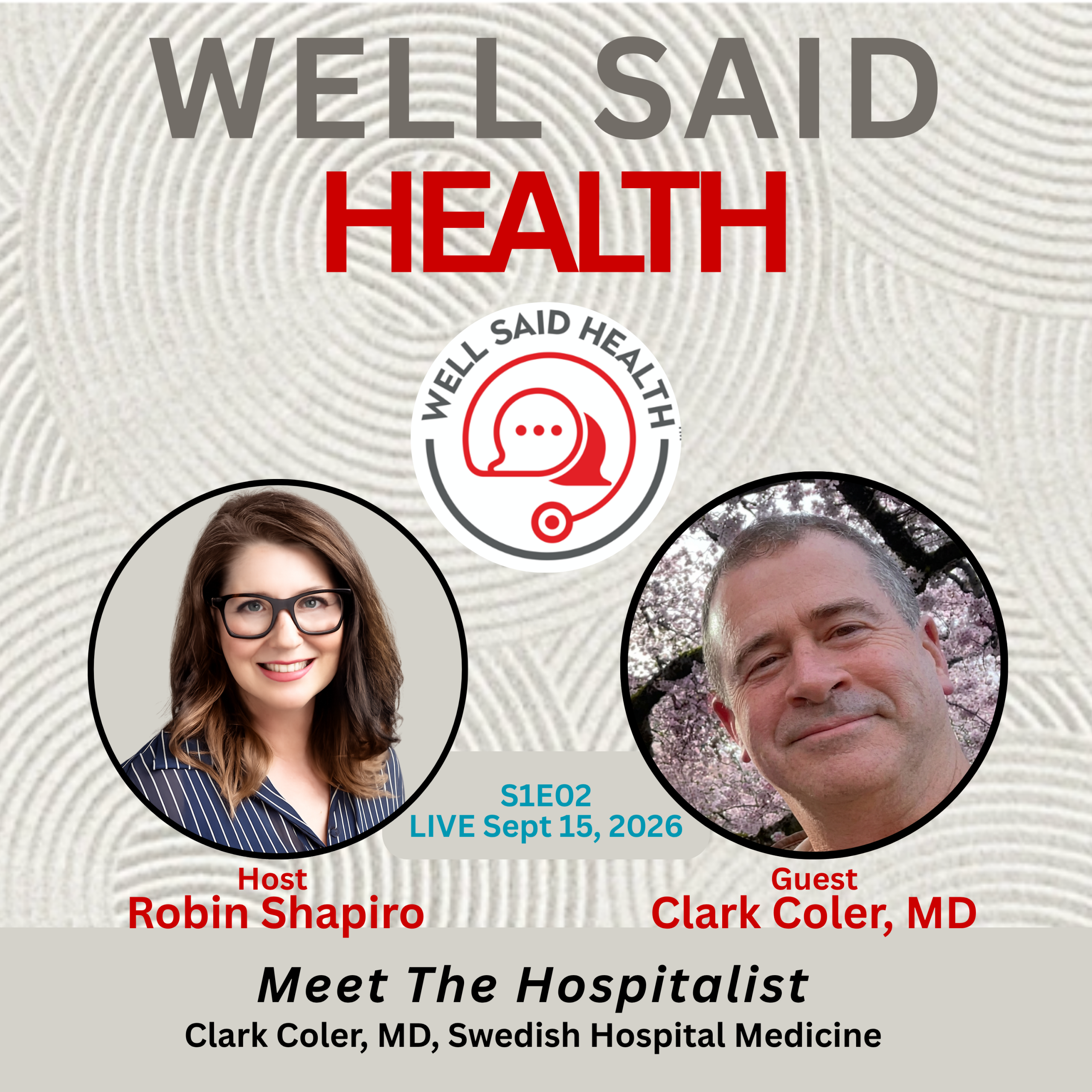
Episode 2
Meet The Hospitalist
with Dr. Clark Coler, one of Seattle’s first hospitalists, 30+ years in hospital medicine
Well Said Health with Robin L. Shapiro
Listen on



Show notes
Every year, 36 million Americans — one in nine of us — are admitted to the hospital. And the physician running the show from check-in to discharge usually isn't the primary care doctor you know. It's a hospitalist: a physician who works only in the hospital, managing the care of admitted patients. Most people don't learn that until they're already in a hospital bed.
Dr. Clark Coler has seen hospital medicine from every side. The son of a small-town internist who made house calls with a black bag, trained at the Mayo Clinic where patients' humanity comes first, he became one of Seattle's first hospitalists when the movement launched in 1994 — and he's spent more than 30 years caring for patients at the most frightening moments of their lives.
In this conversation, Clark demystifies who actually runs your hospital care, why the shift structure matters to your family, the best (and worst) days to be admitted, why discharge is where mistakes happen — and the exact questions that get you and the people you love better, safer care.
Download complete Show Notes in PDF format.
TRT43:25
S1Ep02 – Meet The Hospitalist
Robin Shapiro (00:04)
Welcome to Well Said Health. I'm Robin Shapiro.
Here's something that happens every single day in this country, and almost no one talks about it. A person gets admitted to the hospital. Maybe it's planned, maybe it's an emergency, maybe it's a parent, a spouse, a kid, it doesn't matter. The point is they're in. And at some point in the first few hours, a doctor walks through the door. Not your personal doctor, a stranger, really.
And if you are the family member sitting next to the bed, you might not understand that this initial visit is so important because later that same doctor, the hospitalist, doesn't come back. And it might be a different doctor and then another. It can get really confusing. And by day three, you might be terrified or exhausted, and you have no idea who's in charge of your loved one's care. This is not a horror story. This is just Tuesday in an American hospital. That stranger, the doctor who walked through the door, is called a hospitalist. And I want to spend a few moments on that word because most people have never heard it and it is costing us not knowing.
A hospitalist is a physician whose entire practice takes place inside the hospital. They don't have an outside clinic. They don't see you for your annual physical. Their job, their whole job is to manage the care of patients who are admitted. From the moment you check in to the moment you go home, your hospitalist is the one running the show.
Here's why this matters to you right now. Even if you're not sick, even if no one you love is in the hospital today, 36 million Americans are hospitalized every year. That's one in nine people. And for those of us in our 40s, 50s, and 60s, managing our own health and often managing a parent's, the odds that you will find yourself in a hospital room in the next few years are not small. When that moment comes, the words you know, the questions you think to ask will determine the quality of the care you receive. This podcast is not medical advice. I'm not a doctor. What we're doing here is giving you the insight, education, specific words to ask for the care you deserve. Today's guest knows this better than almost anyone. Dr. Clark Coler is a hospitalist at Swedish Hospital Medicine here in Seattle. He has spent his career inside hospitals caring for patients at some of the most frightening moments of their lives. He's watched families who knew what to ask get dramatically better care. And that's what I'm hoping we can go over today. He agreed to join us today because he believes what I believe that patients who are informed are patients who are safer. By the time this episode is over, you'll know what to say. And that changes everything.
Here's my conversation with Dr. Clark Coler. Clark, before we get into hospitals, take me back. You grew up watching your father practice medicine. Tell us about that time and put us in the room with you and your father.
Dr. Clark Coler (03:26)
All right, thank you, Robin. Thank you for the opportunity to be here. My father trained after World War II in medicine in the East Coast and had grown up on the East Coast and wanted to see the West. So he came to Portland to do his residency and finishing the residency he was looking for a place to practice and my mother at the time, his girlfriend, said go where you're needed. So he ended up in eastern Washington in the little town of Kennewick and he was the first internist there.
Robin Shapiro (03:56)
Wow what year?
Dr. Clark Coler (03:57)
That would have been probably nineteen fifty-six, fifty-seven. The first half of the twentieth century patients had general practitioners, GPs, and these doctors were heroic figures. They had a huge breadth of knowledge, but not much depth. They came out of medical school and worked for a year in a residency and then just went out into the field and practiced what they knew, which was not much. But they are heroic figures and we all admired them.
An internist, however, had three additional years of training and so was uniquely set up to deal with more sick and complex patients. So having an internist come to your small town was a huge boon for Kennewick, Washington. And when I was a small boy in the 60s, I would go with him on house calls. Doctors worked in the clinic all day, they worked in a hospital through a good part of the evening. And they went out and did house calls in those days. And seeing my father, who was really kind of a George Clooney character, so affable, so compassionate, so warm at the bedside and the effect that had on patients, I had wanted to become a physician since I was a five year old.
Robin Shapiro (05:11)
What you shared with me the other day was quite remarkable in terms of you said that your dad, he had the power to relieve suffering with words and touch alone. And so take us into a patient's room or what you saw and what you mean by that.
Dr. Clark Coler (05:31)
Well, the house calls were done because the patient lived too far out in the country to be able to get to the clinic or was too sick. Usually the patient was very elderly, usually someone who was close to death. So we would drive out on a dirt road into the countryside around the Tri-Cities, and you'd pull up to this farmhouse, and there'd be dogs barking and chickens, and you'd go inside, and the family was so happy to see him. He had this black bag and this big long black coat.
Robin Shapiro (06:06)
Like what you see in the movies.
Dr. Clark Coler (06:07)
Exactly. You know, he looked he looked like the classic physician coming out with the black bag and the look of concern. But he was such a naturally warm and compassionate person. He was the kind of fellow that could walk into a room of strangers and leave with a dozen friends an hour later. He really, really had the ability to connect with people.
We all aspire to that. That is a bit of a gift. That may be something you're born with and that you cultivate, but it was so effective in making everyone in the room relax. The patient smile, the patient sit up in bed, which they hadn't done for a week. And clearly just the bedside manner was able to make the patient feel better. They were still close to death. They probably didn't have much time left. But they went out of this world with the feeling that somebody deeply cared for them. so watching that bedside manner was deeply inspiring to a young boy. And and I saw that again years later in my residency at the Mayo Clinic. The Mayo Clinic specializes in creating that tone for patients.
Robin Shapiro (07:16)
Right. You shared that the Mayo was really impactful in your career and how you chose to be a specialist and also inform your view of the most effective way to practice. So can you take us back to Mayo and what you learned there, what you saw there?
Dr. Clark Coler (07:35)
Well, Mayo trains a great deal of physicians that go out into the world, but it handpicks among its trainees people that it thinks would be very suitable for the Mayo culture. It's actually a culture that puts patients' humanity first. So when a doctor Yeah, when the attending with his five residents walks into the patient's room, everyone's got a suit and tie on. You can't come to work without that suit and tie on.
And when you walk into there's no lab jackets, there's no white coats to intimidate people. It's all suit and tie. And when you walk in the room, the attending says, What kind of work do you do? How many kids do you have? Where do they go to school? He asks personal questions that give him a connection with the patient. They talk even briefly about sports teams and things like that. And then the physician says, How long have you had this cough? How long have you been losing weight? How long have you had this pain in your abdomen? And launches into the the standard diagnostic questioning. But the patient feels they've been heard from the beginning and they feel they have a connection with the doctor and that the doctor cares about them as a person. So when you see that all day, every day as a resident, it shapes the way you take care of patients for the rest of your career. The Mayo is uniquely focused on the patient experience. In addition to
Robin Shapiro (09:00)
Way before that was a thing.
Dr. Clark Coler (09:02)
Way before that was a thing. And if you don't treat patients with that kind of compassion and respect, you won't last there very long. So they have brilliant doctors that come with amazing knowledge and skills who then leave Mayo a year later because they just aren't a good fit. It's all about the ability to adopt that culture of patient first.
Robin Shapiro (09:23)
And is that also from a language and words perspective? Like do they either train or look for doctors who can communicate effectively?
Dr. Clark Coler (09:32)
They train and look for doctors that have skills in communication, who ask questions rather than just making statements and who talk to patients in a language they can understand. It isn't rocket science. Everybody knows how would you like to be treated as a patient. Well, that's the way you should treat your patients. It's very it's a very simple, basic concept. But it's amazing how many people, as skilled as they are and as bright and well trained as they are, don't have those people skills.
And so they train there, they get a great education, and then they go somewhere else. And so when I was asked if I wanted to be a hospitalist and the fellow described the job to me, which was poorly defined because it was only one or two programs in the country, I said, Well that's kind of what I'm doing now in private practice, spending my evenings in the hospital taking care of my sick patients. I'd love to do that. But the local physician said, Well, that's never gonna succeed because who would turn their longtime patient over to a complete stranger?
Well, the first night we initiated the program, July fifth, nineteen ninety-four, I must have gotten fifteen admissions. Because now the doctors in the clinics could say to the ER, Thank you very much, please admit to the hospitalist, and then it could go back to bed at two in the morning. So the idea of a hospitalist movement is you're gonna get a doctor who's not in his clinic during the day. He's there in the hospital all day long. He's managed the problem you have. Ten times in the last month. He's totally up to date on the current literature. He knows exactly what he's doing. He knows exactly who to call if the problem requires a consultation. And I had the privilege of being one of the first hospitalists in Seattle and being part of that movement. That's cool. The nurses loved it. Yeah. Because they knew who to call. They didn't have any delays in getting a call back. The residents loved it because we were always there to teach them. Patients loved it because again they got a doctor who knew what he was doing, which was most important. And it really improved the standard of care almost overnight. And now it's considered to be the standard in every hospital in the country. Even small hospitals will have someone who's devoted to taking care of the patients that are there.
Robin Shapiro (11:48)
So when the movement started in in the early years, take us back there because I seem to recall that you said it was a little different than it is now. So what was it like when you started as a hospitalist?
Dr. Clark Coler (12:02)
Well, the clinic has patients coming in on a schedule. It's calm, it's quiet, everything is predictable. Maybe somebody will be a little sicker than you thought and need a little extra time. But most physicians working in the clinics have the whole day mapped out from the beginning. As a hospitalist, it's complete chaos. Somebody's having a stroke at five in the morning, they're gonna get a hundred percent of your undivided attention, and everybody else is going to need to wait until you can address their problems.
Every morning you have a different group of patients added to your census depending on how many people you discharged the day before. We would do a three thirty-six hour shifts back to back and then a twelve. So you would admit patients all day. You would try and get some sleep at home, but you'd get another three or four at night. You'd come in the next day, see those three or four in addition to the patients you have, and you'd go home that night after the twelve hour shift was over. Not uncommon to come home at two in the morning. And get back to work at six or seven in the morning. And we did that for a long time. And finally we put our foot down and said, This has been a great experiment, but it's not ready for prime time. And as we were all picking up our hats and ready to walk out the door, suddenly the people who administered our program, that group of administrators are long gone, they suddenly realized that they would have to commit to a fully funded, stable inpatient program because it was really the standard that was developing everywhere. So we went from five to seven hospitalists. Hospitalists and we work a seven day week, twelve hours a day, and then we have a week off.
Robin Shapiro (13:47)
Seven to seven.
Dr. Clark Coler (13:48)
Seven to seven. Seven A.M. to seven p.m. And that's important because there's a lull at seven AM in the morning and it gives the opportunity for people to sign out and for nurses to go off shift.
And it can be a little chaotic, but there's a brief period there where the physicians looking to see how many new patients have been added to their census, who those patients are, what their problems are, and to speak with the nursing staff to see what's really pressing and needs to be done right away. So there's a moment of chaos and focused work from probably seven to eight in the morning. If you're calling to try and talk to the doctor at that time It would really have to be a pressing issue to be able to reach them.
Robin Shapiro (14:31)
That is the worst time 7 a.m. to 8 a.m. Yeah. Or 7 p.m. to 8 p.m. because that's the other shift change.
Dr. Clark Coler (14:40)
Those shift changes, yeah.
Robin Shapiro (14:42)
So it seems that the hospitalist is the central person that every patient and family member needs to know if in the hospital. What does the hospitalist actually do?
Dr. Clark Coler (14:53)
So the hospitalist is an internist, their focus is on diagnosis. And so the hospitalist is writing the meds, doing the paperwork, organizing the consults, making decisions about transfers, making decisions about discharge dates. They really are the conductor of the orchestra, and for many patients, they're the only physician involved in their care. We're trained so broadly that we can manage most endocrine and infectious and cardiology and GI problems on our own. But when somebody needs a procedure done, for example, we call gastroenterology to be involved or cardiology to be involved. And so we make the decisions about who to call and when to call them. And so the hospitalist really is the person if you want to get a broad thirty five thousand foot overview of your loved one's care, that's the person you need to speak to. If you call the gastroenterologist and ask a cardiac question, you're not going to get an answer, probably. They're very bright people but they're very focused.
Robin Shapiro (15:55)
We are gonna shift literally and go into the shift rotation, what patients and families need to know. So trying to demystify the shift structure that you just spoke about. So walk me through your typical day. You walk into the hospital, what does your world look like?
Dr. Clark Coler (16:15)
I head into the hospital and the first thing I do is open the patient list to see who has been added to my census. So if I discharged one patient yesterday, I get one more patient. If I discharge seven patients yesterday, I get seven more patients, people that came in overnight. There's no incentive to discharge patients prematurely. You're just creating more work for yourself.
Robin Shapiro (16:38)
Which I think people would be surprised to hear that.
Dr. Clark Coler (16:41)
Yeah. We have a dis we have a di it's much easier for the doctor if we don't discharge anyone. Yeah. And just keep our senses and know everybody on the service and know exactly what's going on. So you pick up a lot more work if you discharge a lot of patients. And so people often think we're trying to get them out of the hospital. And to be honest with you, we are. Nobody should stay in the hospital one minute longer than they have to. Usually we're just talking about it with them days in advance of anticipating the discharge. I really think your pneumonia's doing well. I think that two days from now you're probably going to be back on your feet. And I don't think you need a skilled nursing unit. I think you'll be able to go home. And the patient will say, Well, you're trying to kick me out of here. And we're like, no, actually, we're trying to coordinate what is a very complex discharge process. And hopefully we'll be able to get a ride for you or have family come and get you on Thursday. And everything will go smoothly and you'll feel well and then we'll arrange for your primary doc to pick you up and see you again in a week in follow up and we'll send all the paperwork to them.
Robin Shapiro (17:46)
And so you have sixteen patients a day.
Dr. Clark Coler (17:50)
Today we are capped with sixteen patients, which was never the tradition, but it's been the recent tradition. And so if there's too many patients to pick up, they'll call in a backup doctor to pick up those extra patients.
Robin Shapiro (18:04)
But it also gives you an understanding from a patient perspective, like why am I not being admitted faster if the flow is going and there are only so many doctors who can take your case, I would imagine, and beds.
Dr. Clark Coler (18:19)
It's mostly driven by the bed situation.
Robin Shapiro (18:22)
So a patient who comes in on a Wednesday, how many different doctors might they see over a week's time? How many different hospitalists?
Dr. Clark Coler (18:31)
The average length of stay for most hospitalized patients is probably three to seven days. Now, we have patients that are in the hospital for a year. Yeah. We have many patients who are there for months. But if you were to look at the standard bell shaped curve, the average patient is probably three to seven days. So if if I'm coming on on a Tuesday and you're admitted on a Wednesday, I'll probably see you as the only clinician seeing you the whole week during
Robin Shapiro (18:57)
During the day.
Dr. Clark Coler (18:58)
During the day.
Robin Shapiro (18:58)
Be a different hospitalist at night.
Dr. Clark Coler (19:00)
There's different hospitals at night, but there's very few things at night where they need to come to the bedside. If you're having a stroke or chest pain or you've fallen from bed, you'll get someone at the bedside right away. If you just want a laxative, they're gonna they're gonna send out a text to the night doc and he'll order the laxative over the computer. So if you come in on a Monday, you're gonna meet Dr. Coler at the bedside. We're gonna have a lovely conversation. You're already feeling a little better from what they did in the emergency room and you and you're you've got your bed and you've got your nurse, and Dr. Kohler says, It's been so nice to meet you. Hello, I'm gonna leave a detailed note of our conversation. But tomorrow you'll have a new physician, and I don't know who that will be. It's one of eight new doctors coming on. So it's one of them, they're all good, they're all lovely people. I would take my family to any one of them, but I can't tell you exactly who's gonna pick you up tomorrow. And patients are a little bit
Robin Shapiro (19:59)
Yeah, they don't know that. They don't understand.
Dr. Clark Coler (20:01)
But they're also a little like how can you not know who's gonna be taking care of me tomorrow? But the system has worked extremely well for many years because the new doc coming on Tuesday morning has all of my notes available to them from the day before and can pick up the ball and run with it. And so the care, the continuity is uninterrupted, but you do get a new face at the bedside. People complain about getting multiple doctors during their hospital stay, but you're getting a free second and third opinion.
Yeah, that's a good big idea. Maybe that the first doctor who sees you is got a good idea of what's wrong with you, but is not spot on. The second doctor who sees you has the wonderful advantage of retrospect and says, you know, I think this is starting to look more like an exacerbation of your emphysema than an ammonia. Maybe there's two things going on. And so the next doc coming on has more information, has the benefit of seeing how you did overnight, and comes up with a fresh new set of eyes. That's a huge advantage to patients, diagnostically.
Robin Shapiro (21:03)
So is there a best day or worse day to be admitted to the hospital if a patient were able to choose and sometimes obviously were not, but
Dr. Clark Coler (21:13)
Patients often get sick days and weeks before they come to the hospital. In fact, you often admit somebody in congestive heart failure and and you say, gee, if somebody had reached out to this poor fellow four days ago, he wouldn't be in the hospital. He just needed more diuretic or he needed a change in some of his meds. All this could have been prevented. So patients, especially men, will wait until the last minute to go to the hospital, which usually means Friday.
So on Friday, our admitting doctors are completely swamped, maybe double the number of admissions. And it all comes in late Friday afternoon because people say, I just don't think I can make it through the weekend. And so there's a huge group of people that come in Friday. There's also a group that says, I do think I can make it through the weekend. And then on Sunday they decide, I really don't think it's gonna work. And so Monday is also a very heavy day for us. Those two days you do maybe twice as much work as any other day of the week. So if you get admitted on a Friday, you have to realize that most of the diagnostic services on Saturday and Sunday are not available except for emergencies. So a procedure that you need is going to be put off until Monday. And then if Monday's as chaotic as it always is, it might even be put off until Tuesday. So waiting all week long with your shortness of breath or your fever or your cough to come to the emergency room on a Friday runs the risk of encountering doctors that are way over busy in a hospital that is way under resourced for two days. You know, the Saturday and Sunday should be two days of healing, not two days of diagnostic workups. I think if I was to advise people, you want to come in early in the week if you can, you're likely to get out of the hospital sooner and have your care uninterrupted and fewer delays.
Robin Shapiro (23:05)
So let me get this straight just to summarize this last section. It's so important and it's probably a mystery to most people. Each hospital shift is from 7 AM to 7 PM for the hospitalists. Right. With the daytime hospitalist taking the load split between all of them during the day, and then the nighttime kind of covering and triaging and taking care of emergencies only.
So what about the overnight shift? What's happening to my loved one at two AM in the morning?
Dr. Clark Coler (23:41)
Well ideally they're sleeping comfortably.
Robin Shapiro (23:43)
Ha ha.
Dr. Clark Coler (23:44)
But most people don't sleep comfortably. Their roommate 'cause many of the rooms are shared rooms. The roommate is snoring or crying out in pain. And so most people the sleep is the sleep deprivation people leave the hospital with is appalling. You know, it's like a fraternity hazing ritual. The bed's uncomfortable. Somebody comes in the room to take your blood pressure every twenty minutes. You get the labs people wake you up at four in the morning to draw your blood, so you have a needle in your arm at four in the morning.
That's done for the physician convenience.
Robin Shapiro
It makes perfect sense if you want to have at the start of your day all the tests to set what you will need for the day. But terribly awful for the patient.
Clark Coler
And we all know that sleep deprivation is its own risk factor for delirium. Yeah. If you're eighty five years old and you function pretty well, I guarantee when you're in the hospital not sleeping at all for a week, you're not gonna be functioning well at the end of the week.
Robin Shapiro (24:41)
We're gonna move on to how to actually reach your hospitalists. So the goal here is we're gonna be providing a language toolkit, which is a signature of what Well Said Health is going to be doing. And so, Clark, you told me something in our prep call that I've been thinking about ever since. You said if every family did one specific thing, there would be no communication barriers. What is that one thing?
Dr. Clark Coler (25:11)
Because of the chaotic nature of especially the mornings, that one thing is really to establish a time when you can either call or speak to the physician. And that time should not be fifteen minutes from now. 'Cause highly unlikely that's going to happen. But the nurses will text me all day long and say, family's been in the room for four hours, now they want to leave. Can you come right away? And I'm in the ICU with a patient and I can't come right away.
And I've missed the opportunity over those four hours to have a lengthy and detailed, very, very important conversation with them. So I need to say I will call them this afternoon, but I would love to meet with them if anyone can come back, or maybe tomorrow morning at a specific time. The physicians really do want to speak to the family. We're not trying to get out of that. It's just that it has to be prioritized along with eighteen other things and and literally five or six other families that wanna be called. And so those calls are very important part of our work, but I can't tell you at eight in the morning what is gonna happen later that day when the cardiologist sees them.
So many times I'll ask the family, let's talk this afternoon. I'll have all these studies done, I'll have the consults done, and I'll be able to give you real information about your loved one and what the plan is. Six hours earlier, I'm as expectant as you are and I don't know what the what's gonna happen. So early afternoon connections with family, preferably face to face at the bedside. There is no substitute for sitting in a room with people and reading their body language and getting a true, full sense of what's going on. And that's especially true with sick people who have very anxious families. So a lot of that anxiety could be allayed by just being in the room together, talking explaining things in language they understand, answering questions. Sometimes it takes ten minutes, sometimes it takes an hour. We're delighted to spend that time because it helps the patient get better. It reassures us that when they go home they have a loved one who's engaged and and knows what they need. It helps to talk about when we think they'll probably be ready to leave the hospital. So those conversations are very important to us as doctors.
No one's trying to ignore the importance of those or get out of those conversations. Now, patients are stressed, families are stressed. Sometimes those conversations are very unpleasant. Mm-hmm. Sometimes the family has already got preconceived notions of what's going to be said. And so you can walk into a hornet's nest as a physician. And all of us, especially after a number of years, learn how to de-escalate that anger and allay those fears and get back to what are we going to do? What's the future look like for your dad? And it's been long in coming, probably should have been in a more supportive environment a year ago. This is the perfect time now to coordinate a move to a skilled nursing facility. So those conversations are very, very important. And some families have truly ten people in the room, and many patients have nobody in the room the whole two weeks they're in the hospital. And so, you know, you get a sense, wow, this guy really doesn't have anyone in town to take care of him.
He really is not gonna be able to go home again.
Robin Shapiro (28:36)
When should families not call the doctor directly and go to the nurse instead?
Dr. Clark Coler (28:42)
Well many times I give people my cell phone number. My younger colleagues think that's insane. The whole generation of doctors are being trained not to give private but it's so much more convenient if you can just call me or text me with your questions. Even three months later, when mom's been home for three months and you say, I don't know if she should still be taking this, I'm delighted to answer that question. I really don't want her to take this medication beyond the three months. Thank you for calling. So I give my cell phone number out. And you'll find that's true of older physicians. Yeah. We don't live in a a paranoid world of fear that we're gonna be hacked. But the young docs really protect that information. Yeah. So I send every patient home with a copy of their discharge summary, arguably written in medical language, but they'll at least see exactly what was done. And my email and cell phone, my private email and cell phone are on that discharge summary. And I would say not more than four or five times a year does anyone use that. And no one's ever exploited it. So it's very effective for getting uncertainty resolved even after the patient leaves.
Robin Shapiro (29:53)
I think you just mentioned earlier patients who have families or someone at the bedside probably are getting more attention, maybe even better care. You said the time of admission is when diagnosis will be made correctly or not. And why does the family matter so much at that moment of admission?
Dr. Clark Coler (30:15)
Interestingly, there's an old idiom that a man with one watch always knows what time it is, and a man with two watches is never sure. What's interesting is that the more information you get, and now these days with the electronic medical record we have a flood of data on patients, the more information you get, the more conflict between different the more contradictory information comes in and the more uncertainty you actually have.
It's very ironic that the more knowledge you have of the patient, the less sure you are that this is just pneumonia. In fact, most patients don't have one diagnosis. Their breathlessness is partly their anemia, it's partly their pneumonia, it's partly a touch of heart failure, they've got some asthma on top of that. And so the diagnostic challenges to an internist is to say, okay, this is more complex than one diagnosis. But the weight you assign to each of those diagnoses, what's the main problem here can change as you get to know the patient.
So on the first day when you're admitting the patient, you know the least about them. You know about their past medical history because you could look that up. But now you need to find out from the wife what's been going on at home. Because the patient will say, I've only been short of breath for three days. And the wife will say, That's possibly true, but he actually used to walk four miles a day. And he hasn't done that for more than a month. So he's not as breathless because he's sitting in the chair now all day. And he clearly is having problems that stretch back months. But the more family in the room to provide an alternative narrative, more detail, somebody else's perspective, the more likely the doctor's gonna get the right diagnosis from the start.
Robin Shapiro (31:58)
That's great. Can you read the long term picture that early on day one?
Dr. Clark Coler (32:04)
This is the conversation you have with family at the bedside. They don't know what's wrong with their grandfather. They want to know what you think is the likely outcome and how long he's going to be in the hospital. And we can use our experience and prediction models. We do it all the time to predict what the risk of surgery is. We do it all the time to predict what the survival is from a certain malignancy. We use prediction models all the time to guide our thinking, knowing that half the time we're wrong.
So family will often say, He's dying. How much time do you have left? And I'll say, I stopped making that prediction many, many years ago, because when you're wrong half the time, you might as well just flip a coin. You know, you're not really helping people to understand the situation better. And much of the predictions we make are based on large population studies. They apply to large populations. They apply to the average outcome. They don't apply to this individual because his outcome is totally unpredictable.
Robin Shapiro (33:04)
Moving on to discharge, you told me if mistakes are gonna happen, discharge is when they happen. So why is that?
Dr. Clark Coler (33:12)
Yeah, discharge is a very complex process. The diagnosis may be straightforward, the care of the patient in the hospital's straightforward, but the patient's about to leave a hospital and go out into the wilderness, and there's a huge voltage drop in the level of care they'll get. Even if they go to a good skilled nursing facility, the goals of care are completely different. They're rehab and rehabilitation rather than treatment.
So at discharge, you need to be absolutely certain the patient is medically ready for discharge. You need to make absolutely sure that they understand that the meds they were taking when they came in are no longer the meds they're going to be on. Some of them will be the same, some of them will have dosage changes, new meds will be added, some meds will be discontinued permanently because they were causing harm. So at discharge, getting the meds reconciled, not only with your own sense of what's going on, but with the family, with the pharmacy, with the primary care physician, explaining in great detail why this was dropped, why this was changed, why this was added. I try to give as much paperwork as I can. Yeah. But I'm not sure many people read the paperwork when they get home.
Robin Shapiro (34:26)
And it might not give the reasons for discontinuing the starting or that kind of thing. So
Dr. Clark Coler (34:30)
Exactly.
So there's a lot going on at discharge, a lot of variability, a lot of potential for communication breakdown, and a lot of risk for harm. Mm-hmm. The healthcare is improving dramatically in terms of the technology and resources we can apply. The service to the patients, how well they're connected when they get out of the hospital, is still hit or miss.
Robin Shapiro (34:56)
We're wrapping up in our last segment and I wanna make sure that we get to the one thing every listener should remember. So if you could say one thing, one thing to the person listening right now, before they ever need it, before anything is wrong, what would it be?
Dr. Clark Coler (35:15)
The physicians genuinely, every one of them, deeply care that you get better, get out, get home, stay home because you're well taken care of. We deeply care about the people we're caring for. That has never changed. Despite all of the distractions that we have today, physicians still deeply want the best possible outcome for their patients. And so having the family engaged whenever possible, from the beginning to the end of the hospitalization, is one way of fulfilling our desire to see things go well. People need to take care of each other before that hospitalization occurs. So establishing family members who are there for you, life circumstances don't always allow that. And if not family, then some advocate who can speak on your behalf. Because you are too sick to remember what I am saying.
I really need somebody else who's feeling well, who especially has some sort of medical background, you know, the someone who's a nurse or a a brother in law who's a physician out in New York. All those people really make a difference.
Robin Shapiro (36:28)
That's great. Clark, thanks so much for joining us on Well Said Health today. And just really so interesting to hear all the intricacies of what the hospitalist is dealing with and how best to get the care that you deserve. Yes. So thank you.
Dr. Clark Coler (36:46)
Thank you for the opportunity to speak to this so important issue. Thank you, Robin.
Robin Shapiro (36:55)
That was Dr. Clark Coler. I want to stay with you for a few minutes because that conversation is worth sitting with. What I keep coming back to is this. Clark didn't just tell us how the system works. He told us how to work the system. And that's not something every doctor is willing to do. So let's use it. Here are the specific questions, the exact words I want you to have before anyone you love is admitted to the hospital.
Write these down, put them in your phone, share them with whoever in your family is most likely to be in the room with you.
Question one. Who is my hospitalist today and how do I reach you or your team? You need a name. You need a way to contact them, not the nurse's station, the hospitalist team. Ask on day one, not day three.
Question two. When are you doing rounds and can my family be here for that? Rounds are where decisions get made. If your family isn't there, they miss it. If you're not well enough to advocate for yourself, someone who loves you needs to be in that room.
Question three What's the plan and what would need to happen for me to go home? Ask this on day one. I know this feels premature, but it's really not. Discharge is the most chaotic underplanned moment in a hospital stay. And if you haven't been thinking about it from the beginning, you will be blindsided.
Question four. What do I need to make sure the next hospitalist knows? If your hospitalist rotates off before you go home, and there's a chance they will, this question is how you protect the continuity of your care. You are the thread that connects your team. This is not a burden, this is your power.
Your homework this week, and yes, there's almost always homework because that's how the show works, is save those four questions somewhere you'll actually find them. Your notes app, a screenshot, a text to yourself. It doesn't matter where. It matters that they're there when you need them. And if you have a parent, a spouse, or anyone in your life who might need this, share this episode with them. You might be giving them something they didn't know they needed.
Full show notes are at wellsaidhealth.com, including a printout of these questions so you can bring them into the hospital. If Well Said Health is useful to you, it would mean the world if you'd take 30 seconds and leave a review wherever you listen. It helps other people find the show, and that's the whole point.
I'll also be answering listener questions or topics you want to cover by signing up for my newsletter at wellsaidhealth.com
I'm Robin Shapiro. Thank you for being here. And here's to your good health.
Wait, before you go, I have a little bonus for you. I ask every well said health guest the same question at the end of our conversation. What are your personal health hacks? What do you actually do in your own life to stay well? Clark Coler has spent 30 years inside hospitals watching people at their most vulnerable. You might think his health hacks would be clinical, but they are not. Stick around, here are Clark's three personal health hacks.
Dr. Clark Coler (40:27)
We all need to refresh ourselves. We all need to rethink about the world, see the world through different eyes. And so I do a great deal of travel. It doesn't really matter where you go, it could be twelve thousand miles away, it could be sixty miles out of town. But I strongly encourage professionals and just about everybody who wants to have a fulfilling life that you get out and see the world through other people's eyes and experience things you've never experienced before and rethink the world constantly so you don’t become just this broken record in your own head.
Robin Shapiro (41:04)
One health hack travel. Number two.
Dr. Clark Coler (41:07)
Well, gardening. Yeah. d whether you're growing tomatoes in the back or you've got sixty rhododendrons you're growing like I do. Gardening is a chance to raise children without actually worrying if they if you kill them. You know? Because you will if you're a gardener, you have killed a lot of plants. Failure is the is the foundation of success. So you need to fail a lot to succeed, ultimately.
And so gardening is a way to learn that philosophy. I'm gonna kill a lot of plants, but the ones I don't kill might grow up to be magnificent trees one day. And I think philosophically that gives you hope and it gives you something to look forward to. It is a constant source of revelation and joy.
Robin Shapiro (41:50)
Any last thing? Third health hack?
Dr. Clark Coler (41:53)
We do a lot of entertaining. My wife is from the Caribbean and she loves dinner parties. She throws a lot of dinner parties. She's a very good cook and she really enjoys people. So I have learned to set the table in ten minutes or less with all the good silver and have everything ready because I've just come home from work and people are showing up in thirty minutes. And I'm always grumpy because I'm always saying, gee, couldn't we do this on another night? But no, and she maintains a very active social life for us and I think other people's ideas, other people's voices in your head are very, very important to your enjoyment of life.
Robin Shapiro (42:35)
Travel, gardening, dinner parties, a man who spent 30 years watching what happens when the body breaks down and what he does for himself is wonder, dirt, and a table full of people. I love that. Now I'd love to hear your health hacks, the small things you do that most people don't know about. Send it to me. I'm collecting the health hacks, and the best ones just might show up in the well-said health newsletter or in a future episode. So sign up for my newsletter at well saidhealth.com and share it there. Thanks for staying for the bonus. See you next time.
