Hospice isn't giving up — it's often the only way home.
Well Said Health with Robin L. Shapiro
Listen on
Show notes
Hospice isn't giving up. It's the only Medicare benefit covered 100% — the nurse, the equipment, the medications, even the supplies, wherever you call home. Yet most families find it weeks, sometimes days, before it could have helped them most. The word standing in the way? Hospice.
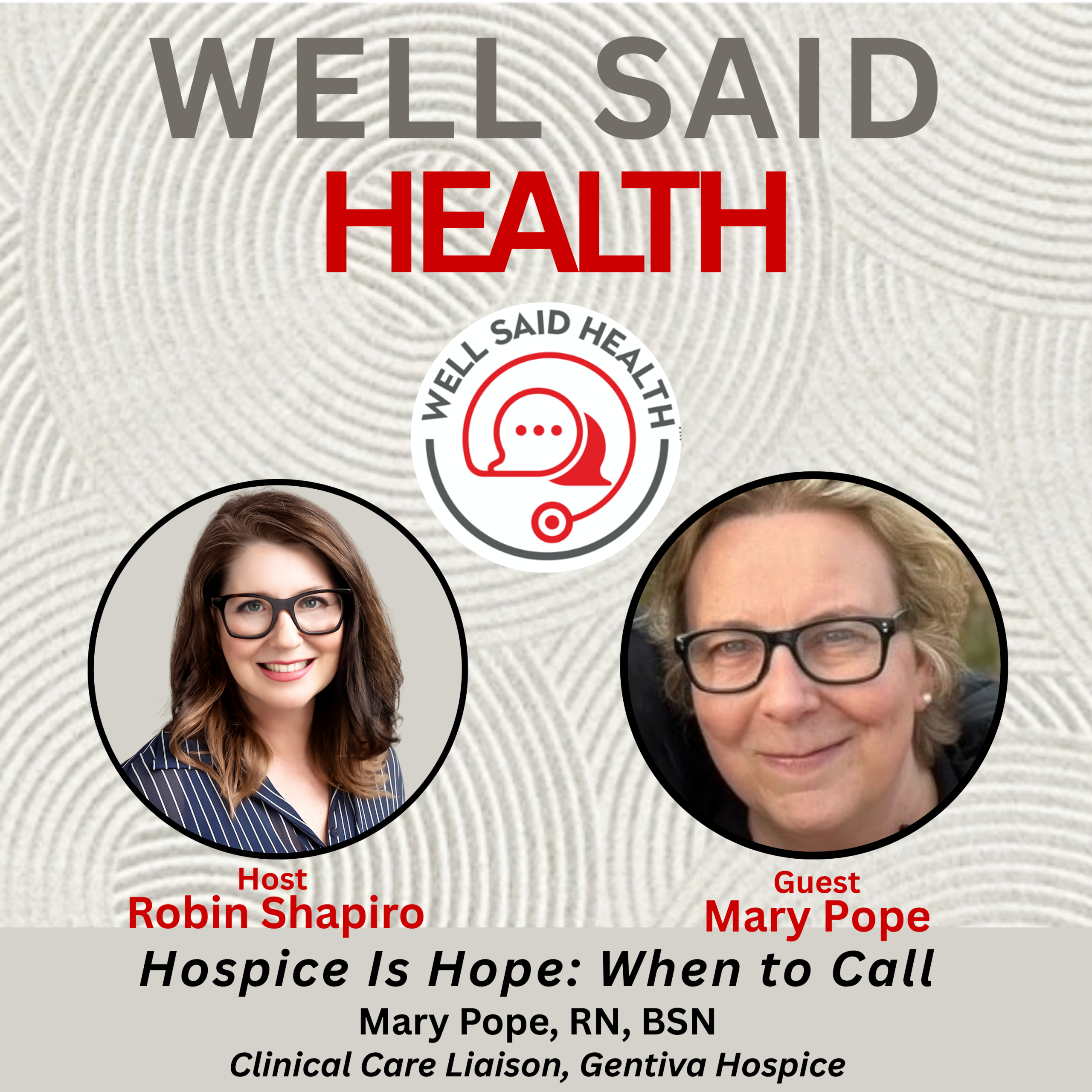
Mary Pope, RN, BSN, came to nursing as a second career, sat at the bedside of dying patients as a hospice volunteer, and worked as a patient advocate — including at Allied Health Advocates, the company Robin co-founded — before taking her advocacy skills to the hospice side. Today she's a clinical care liaison with Gentiva Hospice in the Seattle area, and her whole job is helping families get past their fear of one word.
In this conversation, Mary explains what hospice actually covers, who qualifies and what happens at six months and a day, why hospice becomes your 911 at 2 a.m., and the exact words to say to a doctor who hasn't brought it up. You'll hear about the five o'clock martini, and the 100-year-old man who gained 20 pounds — proof that hospice is a choice. You have more control than you think.
Welcome to Well Said Health, the show that helps you learn the language of health care so you can ask for the care you deserve.
I'm Robin Shapiro.
Every episode I sit down with someone either from inside the healthcare system who shows us how it really works, or someone who's had a personal experience with it, and give you
the words to navigate that situation better.
A quick reminder before we begin, I'm not a doctor and nothing on this show is medical advice.
Every situation is different.
Always talk with your own healthcare team about decisions for you or your loved ones.
What we're here to do is
is help you have those conversations well.
Here's a statistic about having control about where you choose to die.
When asked, about 80% of people say they want to die at home, but in reality only about one third of people actually successfully do.
The bridge between these two, the one almost no one understands until a crisis, is hospice.
It's the only Medicare benefit that's covered 100%.
And most families find it weeks, sometimes days, before it could really have helped them the most.
My guest today is Mary Pope, a registered nurse and hospital clinical liaison in the Seattle area.
Mary and I go way back.
She was a patient advocate for the company I co-founded, Allied Health Advocates, before she took her advocacy skills to the hospice side.
Her whole job now is helping families get past their fear of one word.
Hospice, so you can get the care they've said that they have wanted all along.
By the end of this episode, you'll know exactly what hospice covers, who qualifies, why, when on hospice, you should call hospice before you call 911, and the exact words to say
to a doctor to start the conversation.
And stick around after the show for Mary's three personal health hacks.
Here's my conversation with Mary Pope.
Mary, welcome to Well Said Health.
Thank you.
So you went from the business world to nursing school to advocacy and now hospice.
What pulled you towards hospice work?
I think I have just always been interested in the mysteries of end of life.
You know, I went to nursing school as a second degree, as a second career, and part of my interest was just those deep conversations and understanding, learning, curiosity about
what happens to us through the lifespan and at the end of life.
So
Even you know, before I started health advocacy, I was volunteering at a local hospice facility, just sitting at the bedside of dying patients and doing life reviews with them
and helping the medical assistants change and turn and take care of people after they died.
So yes, I'm an RN and a hospice clinical liaison.
And my job is to be in the community.
Helping people really understand what hospice is, helping people try to be less afraid of the word so that they can actually benefit from the service.
I'm out there trying to destigmatize, demystify the term hospice, and really again help people take advantage of this incredible Medicare benefit that really provides the end of
life care.
That most people say they want when they think about what they'd like at the end of their life.
You said that the biggest myth of hospice is that it takes away hope, but that you have actually seen it giving hope.
Can you tell us what you mean by that?
The hope comes from having an end-of-life experience that is comfortable and in a location of the patient and family's choosing, and with sort of education available all the time
and clinical support, not present all the time, but available by phone, who can come to see the patient.
And so I th I think that's the hope that I see for people is just this hope of an end of life experience that is not scary or less scary for people and kind of beautiful in many
ways for the family.
So
So what does that mean if somebody, you know, might have an interesting, you know, desire to do something?
How does that jive with hospice?
This is a a story I tell, which is is it didn't actually happen, but it's just a scenario that I like to describe.
I see our job in hospice as helping patients get what they want at the end of their life in a variety of ways.
And if that looks like for the patient that they envision having a martini at five o'clock every night in their hospital bed with all their friends around them who have come to
you know, regale them with jokes and stories and songs.
Our job is to make that patient comfortable enough.
We don't make the martini, but we are there to make sure that they're comfortable enough, that they're awake at that time of day if that's what they want to do, and that they have
all the support that they need to do that in their home or wherever they call
And I think you had a stat about the difference between how many people say that they would like to die at home, but how many actually do.
The stats have always shown that when asked the question, the majority of people say that they would like to die at home or the home of a loved one.
The vast majority of people say that.
And yet, the vast majority of people die in the hospital.
And it's really, it's really sad.
I think again, it's in part a lack of awareness that hospice is often the way.
for almost anybody to get from a hospital, even in a an acute medical situation, from the hospital back home.
And so I really like to encourage people to understand that and help them see if that's really what they want.
There is often a way to do that.
Great.
So let's get concrete about what is hospice in plain language.
How do you describe it
it.
So hospice is one of the four Medicare benefits.
It is the only benefit that is paid for 100%.
So the other benefits are hospitalization, skilled nursing or rehab, and home health care.
All of those other three are Medicare benefits, but they're paid out at there's a percentage that you know your deductible has to pay for.
That can be a lot of money out of pocket, especially for hospitalization costs.
But when it comes to hospice, it is the one benefit that Medicare agrees to pay 100%, at least for now.
And the things that are provided are very similar across hospice agencies.
Because this is a federal Medicare benefit, they have to have some consistency across agencies.
So the team is made up.
In our case, of an RN case manager who's assigned to a patient.
And again, in our case, that nurse starts at two visits a week with their patient.
Then other members of the team include a bath aide who will also come at least two times a week, if desired, right?
And a social worker, a chaplain, and our medical director who oversees this team of people and oversees medication orders.
And equipment and all all those kinds of things that are needed.
And
This is a hundred percent paid for by Medicare for anyone.
Yes, anyone who qualifies for hospice.
And we can talk about qualification in a minute.
But yes, one thing to note, especially in terms of the nurse and bath aid, and this is a really major thing for most people, all the nurses on who work in hospice will come for
these routine visits, right?
And they'll be there anywhere, ~ in our case, usually 45 minutes to an hour per visit.
They'll do vital signs, look at
somebody's skin integrity, make sure they're comfortable, update any ~ medication, distribution, times of day, amounts of medication, et cetera.
But they are not there 24-7.
They're just there for those clinical visits.
Same with the bath aid.
So our bath aids will come about twice a week or occasionally more than that, sometimes less than that.
People don't always want a bath aid twice a week, but
Those people will also be there for about an hour to help the patient get into the shower or the bath if that is something that they're able and want to do.
Otherwise, they'll help the patient with a bed bath in their hospital bed, help them get ready for the day.
But again, they are not there to provide the bulk of caregiving that many, many patients require at the end of life.
And this is a real gap in care.
Right, not just hospice care, but I always want to make sure that people understand that because they will need, as a family or a patient themselves, if they're able, to kind of
arrange for caregiving or arrange to move somewhere where they can have access to wraparound care.
So that that is the one gap that exists that I can see.
So the other bucket is the stuff that people need.
when they get to this stage of life.
So and again, this is all paid for 100% by basic Part A Medicare.
So a hospital bed, the kind that goes up and down, head goes up, base goes up.
Usually they have half rails that go up and down.
So that the patient is sort of aware that there's an edge to the bed.
And sometimes they use that as a leverage, a rail to as leverage to swing their legs over if they're still able to get up and out.
Sometimes people want one of those air mattresses that expand and contract to prevent bed sores.
That is another thing that hospice can provide for those who need that.
Wheelchair walker, over-the-bed table, bedside commode, shower chair, a hoyer lift, if that's something that would be required or helpful for moving a patient from bed to chair,
for instance.
So that's the equipment.
Also included are all the medications, again, at 100% cost paid for.
The medications that align with the patient's hospice diagnosis.
So, you know, some people are very attached to certain medications that they may have been taking for years.
Often, that's like a statin medication or a vitamin, you know, D or fish oil or something.
The patient can still take those things, but those may not be covered by hospice.
But anything that aligns with whatever their hospice diagnosis is will be covered 100%.
Also included are incontinent supplies, so briefs, wipes, gloves, bed pads, shower supplies, you know, lotion, shampoo, bath soap, all of that stuff is supplied by hospice.
And I want to get into eligibility in a moment, but before we do that, you told me we become the patient's 911.
So what does that mean at 2 a.m.?
So say something happens at 2 a.m.
and the caregiver who's there at the bedside or the patient themselves is afraid, maybe their pain is uncontrolled, maybe they fell when they tried to get out of bed.
So we ask, and during admission, we really encourage that we become the first call that anybody makes before they call an ambulance or the hospital or their doctor.
And then
We answer the phone, somebody answers the phone 24 hours a day, seven days a week, and we'll triage that situation.
Maybe it's a matter of just answering the question of how much morphine do I give to my dad who he's really having a pain episode now, right?
In that case, we're just there again to kind of educate, teach, coach.
But sometimes people really need a visit from a nurse.
So then we put them on the schedule of whoever is.
On call, and then our nurse will will come to see that patient as soon as possible.
Very occasionally, we do suggest that the caregiver or the patient themselves calls 911 and has, you know, the EMTs come and take them to the hospital.
That's usually when somebody may have fallen and say they kind of got a gash on their head and they're bleeding, and trying to control the bleeding is difficult at home.
But still calling us first is really important because then we call the hospital ahead of time and tell them that this patient is on their way to you and they are on hospice
service.
So please treat them, stitch them, whatever needs to happen, and send them home because that is their choice.
Don't
do not admit them to the hospital.
Once they get admitted to the hospital,
They automatically get bumped off of hospice because they revert to a different Medicare benefit.
That would be the hospitalization benefit.
So if it wasn't clear, which it might not have been, of those four benefits: hospitalization, skilled nursing, home health, and hospice, you can really only use one of
those benefits at a time.
And so if you're on hospice and you go to the hospital and get admitted.
Then you automatically get bumped off of hospice because your Medicare plan will pick up the hospitalization costs at whatever the rate was that you had before.
But as you know, many people can go to the hospital and be in the hospital without being admitted for one, two, or sometimes three days, which is kind of ridiculous.
But also in this case, it can be helpful because they can get some of the treatments that they need and then go back.
I think not necessarily everybody would know that.
So that's a very important tip.
Thank you for sharing that.
So let's move along to eligibility and the secret language that you need to know in order to actually get on hospice.
So what is it?
What's the trick?
So, hospice is a program for people who have been given a likely prognosis of six months or less to live by their doctor or a DO or an MD if their illness, their disease follows
its typical trajectory.
And there are, you know, most of the diseases that we experience in our elder years.
We know the the trajectory of those illnesses.
So COPD, dementia, congestive heart failure, stage four cancer, end stage kidney disease, neurological diseases like Parkinson's and ALS.
We we have a good idea of what the pattern and trajectory looks like.
So it's always an educated guess on the part of the doctor, but when they deem that the patient
Is likely to have six months or less to live if their diagnosis follows its typical trajectory, then they may, but they don't always bring up the topic of hospice.
But the patient and family can also bring up the topic of hospice if that is something they want to learn more about or they think they might be eligible for.
I have found that as great and amazing as doctors are, there is still a reluctance.
To bring up hospice with people.
And I feel like it should be part of the conversation long before people really need it.
But it's sort of these are the tools we have, depending on how things go.
And hospice is just one of the best tools.
Again, it is important to put aside the stigma, the fear, the thinking that it's taking away all hope of the word hospice.
And in order to get the enormous
benefit that hospice provides.
And but so many people don't think about it, they don't consider it, or maybe they haven't been told about it by their medical team until the final few days or weeks of life, when
in fact the family, the patient could all be taking advantage of this incredible care in the home or location of their choice much earlier, right?
So
So the benefits of going onto hospice service at on the earlier side of eligibility are enormous.
So when you are able to connect the hospice team and the patient and family on the earlier side of eligibility, you have some time to build that relationship of trust.
You have time for the nursing clinical team to kind of figure out, okay, so this patient came back from the hospital on this pain medication, but it's not really working very
well.
Let's try this other type.
Let's try a different time of day.
Let's try a different delivery method or a different dose, right?
And there's time to play around with that, all of those things, anxiety medication, oxygen needs, equipment that could be helpful.
You know, when people get to the very end of their life, it feels like a crisis for a lot of people, family members, especially.
The patient may be waking up in the morning and have to focus all of their
time and energy on just breathing in and out instead of being able to really enjoy the care that they're getting, the comfort that they're able to have there in their own home,
to receive guests, to have these really important conversations that sometimes only really happen when somebody knows for sure that time is limited.
You know, I I just wanna jump in here because what you're saying is really bringing up for me when my dad was diagnosed with brain cancer and he, you know, he had glioblastoma in
Hawaii and of course I didn't live there and I'm thinking about all the other families whose loved ones, you know, live far away and they get this devastating diagnosis.
And we did not get referred to hospice right away.
We had it towards the end.
But I know that we arranged, you know, hospital bed and all this other kind of stuff.
And it was a very dynamic situation because it wasn't like he was in a hospital bed the day he got his diagnosis.
But every single day that he lived, he lost a little bit of his mobility and h his self.
And we were arranging all those things like crazy people trying to figure it all out.
And I'm just thinking if we had gotten on hospice right from the get go, that likely would have been a lot easier and certainly a lot less expensive.
I mean, my goodness, that it's all covered.
That's inc just incredible.
Yeah.
Sometimes it is hard though to hear like you have this diagnosis and hospice is the only option for you.
So I understand why there would be some gap in you have this diagnosis, it's a really bad diagnosis.
These are the things we have to offer you.
And at that time, even if hospice is too soon, either emotionally for the family or physically for the patient right in that moment.
It's still a right time to bring up what can be helpful down the road.
Because, like with any word that has a lot of weight and import, cancer, diabetes, you know, anything that's like a chronic or deadly terminal illness, a patient has to register
that and maybe even hear it a few times before it really sinks in and they connect themselves to that word.
So I think hospice is one of those words.
And I always remind people that hospice is a choice.
And that can help people recognize that even if in the moment they are eligible for hospice, but they still have this sense that their loved one is going to be the one in
500,000 people who has a radical remission or whatever from whatever they're dealing with, they can then go off of hospice at any time.
So they choose to go on hospice, they get all the care and equipment they need.
And then if there is a a big change in somebody's status, they can choose to go off of hospice.
You know, even if they're eligible, it's a choice to go on.
So what happens at you know, it's supposed to be, you know, within six months, a diagnosis within six months.
So what happens at six months and a day?
Is there a cliff or what happens?
Do you get kicked off?
Yeah, not that long ago, people actually did have to roll off of hospice on the day of the, you know, the day after the six month mark.
That was part of the Medicare kind of strict guidelines.
Nowadays, it doesn't work that way, as long as the patient still has the diagnosis they had when they went on to hospice services.
And as long as they're not making remarkable improvements.
They can still stay on hospice and they get recertified by the nurse who will have to do an official recertification, but they don't have to get bumped off or change their team or
anything like that.
So, yeah, so that's a really important thing.
As you know, Jimmy Carter, our former former president, was on hospice for brain cancer for two years.
So he just kept getting re-certified.
And I mean, the data shows that most people.
So the majority of people who go onto hospice live, on average, a month longer on hospice service than off of hospice service.
And you can imagine why that happens, right?
They're where they want to be.
They are surrounded often by loved ones or friends.
They're made to be comfortable.
That's our entire job.
And they get to do what they want within their ability.
And that tends to
lead to a longer and better quality of life.
So
So we're gonna give a secret language moment to listeners here.
So if a doctor hasn't brought up hospice and a patient doesn't wanna die in the hospital, what are the exact words to bring up with the doctor to start the conversation?
I would say, so how long do you expect that my loved one may have?
I know you can't say for sure, but I mean, are you guessing three weeks, three months, three years?
If it's not clear that we're moving fast or slow, I would ask.
And if the doctor says, I really don't think they have very long, you should get your paperwork in order, et cetera, then you can ask, you know, would hospice be appropriate?
for my loved one?
And if so, can you work on getting a referral or an order for us?
And hospitals are very used to doing that.
But when they get to a point where they're told, we don't really have anything else to offer you.
Andor the patient themselves said, I am done.
I've been dealing with this for five years.
I just don't, I want to go home.
I want to be comfortable and I want to just enjoy however much time I have left.
Hospice may be the right step for them.
And again, a doctor really, especially with those points, should say, Well, let's talk about hospice, right?
If the doctor doesn't do it, then the family has every right to say, maybe hospice is the next right step.
For people who are living in an assisted living facility, an adult family home, it can also be the care director.
nursing director in those communities who may be the first person to bring up the word hospice with a family.
Can those people refer to hospice?
They can refer a patient and family or a resident and family to a hospice company for more information.
And then a referral is a little bit different than an order, but sometimes they are used interchangeably.
A referral can happen from anybody.
You or me or a neighbor could say, I think you should just learn about hospice, right?
Here's the name and number of somebody I know, or I've heard good things about this company.
So that would be a referral.
An order is what we need in order to schedule a person for evaluation and admission to hospice.
And a doctor, a DO, an MD needs to write the order for hospice services.
If the family doesn't have that, but they know based on criteria that their loved one qualifies, oftentimes the hospice person myself.
Included, I've done this many times, can call the doctor's office and get the hospice order so the family doesn't always have to handle that part.
But we must have an order in hand in order to admit somebody.
And even still, sometimes a hospice order is not quite enough to actually qualify somebody in that moment for hospice services.
So a hospice order gets the patient an evaluation.
To admission by the hospice team.
But we, because this is a Medicare benefit and we are paid by Medicare, we have to follow the data guidelines and we need a certain number of data points in order to ensure that
yes, indeed, this person does qualify for hospice under the Medicare guidelines.
And so the things that we're looking for are a patient who has been losing weight without trying.
who's just not interested in food, whose mobility may have changed.
Maybe they were using a cane, and a few months later now they're using a walker, and now today they're in a wheelchair or they're bedbound.
Somebody who's sleeping much more than they were before, even if they get up and sit in a chair, they're sleeping in the chair most of the day.
Somebody who's having new wounds, frequent wounds or slow healing wounds.
Somebody who's having increased pain, increased shortness of breath, those are all the things that we look for.
And obviously the diagnosis that the medical doctor has referred or ordered on the hospice order will be primary to what we're looking at.
So
So let's say a family says yes, patient says yes, I want to get on hospice and they are eligible.
So what does the first forty-eight hours look like?
So we was schedule the patient, and we really like to have a family member present.
Oftentimes the patient is just not even able to register what's happening.
So then our admission nurse will schedule a time for admission.
That's usually like a two-hour process.
Then the nurse will go out, do the admission.
And once that admission is complete, the patient will be admitted to hospice.
Within a day,
We try very hard and we're usually successful to have within the day their RN case manager come out for a visit.
But again, it's a Medicare requirement that the minimum is that a patient is seen once every 14 days.
We think that that's not nearly enough.
So that's why we see patients at least twice a week to start.
So Yeah, great.
Unlike other Medicare benefits, nobody gets kicked off of hospice for not improving.
So why is that distinction so important?
It's important, I guess, because it still allows for the hope of improvement to live alongside the hope for an end-of-life experience that is kind of what you imagine.
I told you the story when we talked before of there was a a gentleman on our service when I first started in this role who was a hundred years old, and he had been a hospice order
had been written for him by his doctor.
with the diagnosis of failure to thrive, because this gentleman had been losing weight, a lot of weight, over the period of a few months.
And the doctor believed, understandably, that this patient probably had some kind of disease process going on that was ultimately going to lead to the end of his life.
But rather than poke and prod and put him through a bunch of testing and machines, the doctor was able using his weight loss and his age to write him an order for hospice.
And at that time, our social work team was able to help this gentleman who was living alone at that age find an adult family home that met his needs.
And so he moved into this adult family home with, you know, between four and six other residents and at least one, but probably two caregivers around.
And in those adult family homes, people ~ you know, the food is cooked right there in the kitchen, which is
usually in the heart of the home and the bedrooms are all around.
So you it's like a home, right?
And everybody eats their three meals together.
And this gentleman proceeded to gain 20 pounds in like his first three months on hospice.
And it turned out he was just lonely.
And so he rolled off of hospice.
And that was a great, you know, story.
And he died of natural causes living in an adult family home.
Surrounded by people who grew to care about him and he grew to care about them.
Sometimes when you're really comfortable and all of your needs are met, you start feeling really good.
We know that that happens naturally, even in the declining trajectory of death.
We call it a rally.
Sometimes people rally for you know a week or two.
We give the rally, you know, time to kind of determine whether that's really what it is.
But sometimes people just improve.
And then they do end up having to roll off of hospice.
But again, we follow them, we get, you know, we stay in touch with the family.
And if something changes and the person begins to decline again, we can take them back onto hospice service at that point.
If you're the family member getting a whole list of hospice organizations, what are the top three questions to ask in terms of screening a hospice?
Yeah, I mean one of the key questions I think is what is your nurse-to-patient ratio?
So you want to know that the nurse is not so overwhelmed with the sheer number of hospice patients that he or she is seeing on a regular basis so that they can provide the care
that your loved one needs.
Another one is what is the standard frequency of visits?
And how long do does a nurse really stay?
What do they do when they're there?
What does an emergency response look like?
Does a human answer 24-7?
And it looks like you mentioned before that you should check Medicare's compare website and cross-match reviews.
So you can do that.
Yes, you can look it up.
A really good question to ask or research to do before you sign on to any hospice organization is to look at reviews.
Hopefully everybody is already doing that before they seek a mechanic or a primary care provider, but also a hospice agency, right?
Don't just look at one set of reviews.
Look at as many reviews as you can find.
Make sure you're looking at the dates.
If those negative reviews are from five years ago, then they might not be applicable, especially in healthcare, because the turnover of staff and ownership changes all the
time.
But it is really good to look at reviews and to look at the Medicare website that lists providers and star ratings, etc.
Yeah, so there are ways to do a little research.
Ask around too if you know people who have.
Had a loved one on hospice, ask what their experience was, if they would recommend the organization that they used, what things worked really well, what fell through the cracks,
and that can inform additional questions that you would ask that particular hospice agency.
Yeah, aside from nurse ratio and visit frequency training, credentialing of not only the nurses and medical director, but the bath aids too.
You want to make sure that they are certified CNAs or MAs.
I mean, all the things that you can think of that would be important if you were taking care of your loved one, you know.
How do you get a hold of these people?
You know, ~ always ask, like, will I be given a direct contact for our RN case manager?
Every once in a while, a family will get that.
you know, have created that relationship and get that contact information.
It's not always the right thing to do though, because sometimes that nurse is just not on duty and not checking their phone.
So it this is why it is always best to go to the main number that you've been given, which I say is the 911 for most patients.
And the question you know, asking the question, does somebody always answer the phone?
How long might it take for a nurse to get to my loved one?
If we're calling after hours, those are some of the questions that that I can think of.
And you don't have to ask them all at the beginning, right?
It's a relationship.
You know, there are some key things to know when you're choosing a hospice agency, but you can fine-tune things as you go and give feedback to your direct team and also to the
company at large.
So
So your closing message when facing your own mortality and, you know, the unexpected call at two AM, what do you wish every listener would keep in mind or do this month related to
this topic?
The message is we are all going to die.
And you have much more power and control over what that process looks like than you might think.
But in order to exert that control, to have that influence and agency, you've got to do some planning ahead.
And not everything is planable, but a lot of it is.
So that's my message, I guess.
You have more control than you think.
And plan ahead.
Yeah, yeah, Mary, this has been such a great conversation.
Mary Pope, this was very important and I know that a lot of people will be getting a lot out of it.
And so thank you so much for joining us today on Well Said Health.
Yeah, thank you.
Now for my favorite part of every episode, the toolkit.
One page, everything you need to act on what you just heard.
Download it for free at wallsethealth.com.
Here's what's in episode four's hospice toolkit.
First, know the benefit.
Hospice is one of four Medicare benefits and the only one covered 100%.
The team, the equipment, the medications, even the supplies, wherever you call home.
Second,
Know the signs that could qualify you for a hospice referral.
Weight loss without trying, keen, then walker, then wheelchair, sleeping more, wounds that won't heal.
Those are the signals a doctor uses and that you can name.
Third, know the words to use with your doctor for a referral to hospice.
You can say, I don't want to go to or go back to the hospital.
I want to be comfortable at home.
Would hospice be appropriate?
And can you write the order?
You don't have to wait for a doctor to say it first.
Fourth, once you're in hospice, call hospice first if you think you need to get urgent care.
They become your 911 because a hospital admission bumps you off this benefit.
And fifth, interview your hospice choices, the ratio of nurses to patients, the visit schedule.
Who answers the phone at 2 a.m.?
The full question list is in the show notes toolkit.
If this conversation helped you, my book, The Secret Language of Healthcare, How to Ask for the Care You Deserve, is full of scripts just like these.
You'll find it linked in the show notes.
Grab the toolkit and subscribe to the newsletter at wellsethealth.com and follow the show on Spotify, Apple Podcasts, or wherever you listen.
I hope it really truly helps you and by subscribing you can help others find us.
I'm Robin Shapiro, say what you need, be well, and here's to your good health.
One is my Oura ring, which I really love.
It has just helped me have insight, especially into my sleep, but also my activity or lack of activity.
So I really like it.
And it's so simple.
Like I wore an Apple Watch for a little while, and that just was too much information for me, and I couldn't see it very well.
So I don't know.
The Oura ring and its software are just easy breezy for me.
Another thing.
the a change I've made is that I have been drinking a bit less alcohol, probably a lot less alcohol over time because I, you know, especially during COVID, our drinking ramped
up just for fun.
But especially over the last year and all of this constant information about how any amount of alcohol is really not good for your health, I still enjoy wine or a cocktail
from time to time, but my drinking overall has decreased quite a bit.
And then let's see, one other thing.
I I am in a book club that I've been in for 28 years probably, and we still meet regularly.
And I would say that is another kind of health hack or whatever.
Because first of all, it keeps me reading and reading things that I might not necessarily fall back in, you know, my comfort a little outside of my interest or comfort level.
And it also just creates this ongoing history and connection with a wonderful group of women.