Episode 1
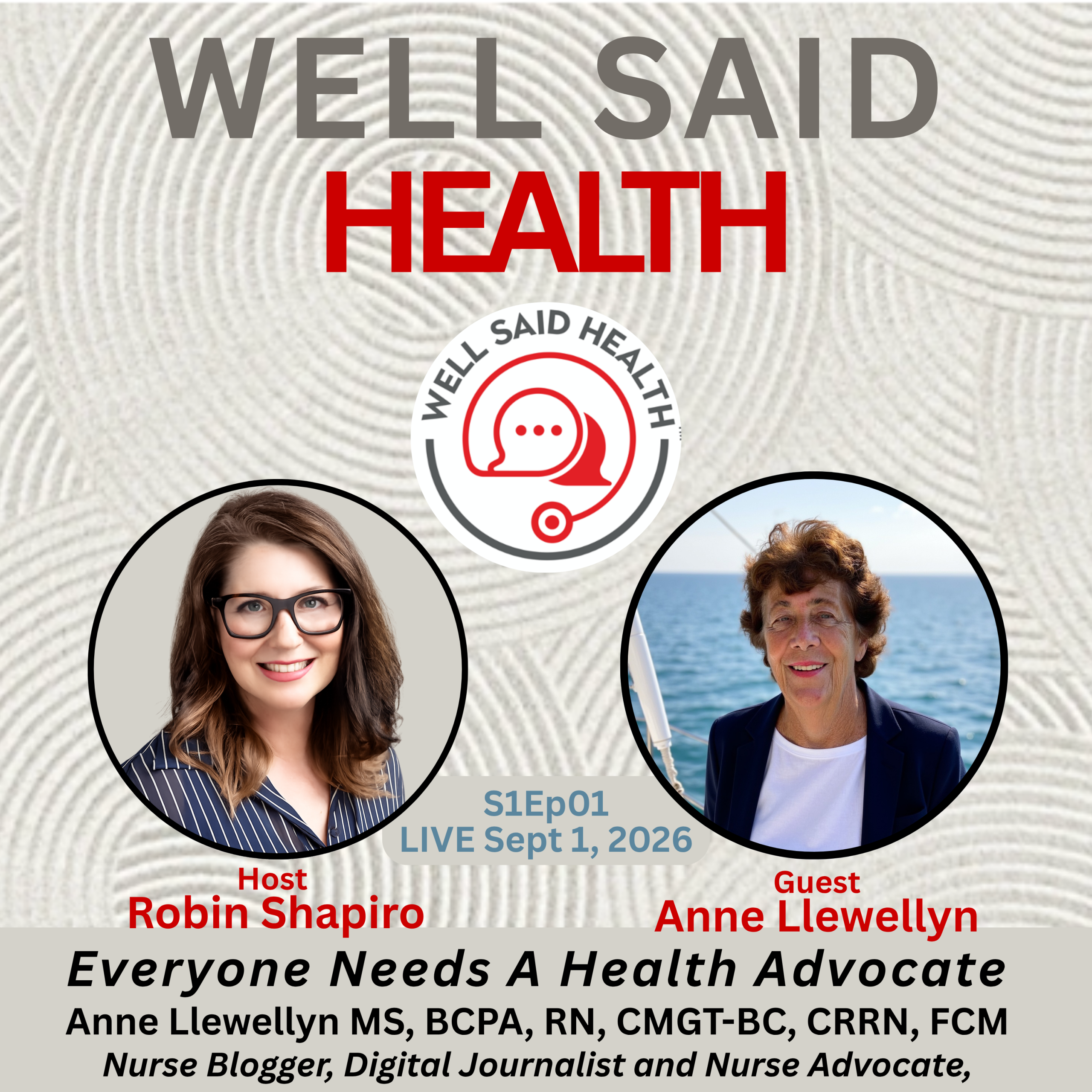
Why EVERYONE Needs a Health Advocate
with Anne Llewellyn, nurse advocate and author of the foreword to The Secret Language of Healthcare
Well Said Health with Robin L. Shapiro
Listen on



Show notes
Anne Llewellyn helped invent the health advocacy profession — then, in November 2014, a sudden brain tumor diagnosis made the advocate's advocate need one of her own. Anne shares how two advocate friends and her husband Corky (a mechanic with a $3 notebook) changed the course of her care, from a small community hospital to a top cancer center. Then Robin turns the story into a toolkit: the exact words to use before and during a health crisis.
Download complete Show Notes in PDF format.
S1Ep01 – Well Said Health Podcast with Guest Anne Llwellyn
TRT 43:22
Robin Shapiro (00:04)
Welcome to Well Said Health, the podcast that spotlights real people's stories to help you navigate care better. I'm Robin Shapiro.
Have you ever sat across from a doctor, heard something you weren't expecting, and realized you can't remember a single word that came after? There's a reason for that. When fear walks in, your ears walk out. And that's exactly the moment you need someone standing or sitting next to you.
Today we're talking about why every single one of us, no matter how smart, how prepared, how experienced, needs a health advocate. My guest is the person who helped invent the profession. Anne Llewellyn is a pioneer of health advocacy, a leader in case management since 1988, before patient advocacy even had a name. She's a critical care nurse, an award-winning nurse blogger, a journalist, and she wrote the foreword to my book.
The Secret Language of Healthcare, How to Ask for the Care You Deserve. Anne has spent nearly 40 years helping patients find their voice. And then one day in November 2014, the advocate's advocate suddenly needed one of her own. Anne, welcome to Well Said Health.
Anne Llewellyn (01:25)
Thanks, Robin. Glad to be here.
Robin Shapiro (01:27)
Why did the whole field of independent health advocacy even emerge? What was missing that the patient advocacy profession now fulfills?
Anne Llewellyn (01:39)
I think the patient's voice has been missing. And that I think is the missing link within the challenges within the healthcare system. The patient is the one who is sick. The patient is the one who really has to understand their condition after it's diagnosed or know their symptoms, know what is helping, hurting, to let a doctor know that. If they're not involved, then we're really just dictating care.
Whereas having an advocate really encourages because many people, they're not nurses, they're not case managers, they're not doctors, pharmacists, they're regular people who are scared and who when when they get a diagnosis, cancer, a spinal cord injury, a traumatic brain injury, they don't know what to ask. We, on the other hand, as healthcare professionals, do know that science. We know the barriers that are going to happen because of the condition, and we can help them understand that so they can move forward.
Robin Shapiro (02:44)
That's a perfect transition to talk about when somebody as experienced as yourself in patient advocacy and all the different aspects of that, as well as case management, actually needed an advocate. So in November of 2014, you're in Las Vegas teaching an eight-hour course, wearing brand new glasses. Take us to the end of the day that day, and what happened?
Anne Llewellyn (03:12)
Well, I couldn't see the slides. I was right in front of them. And I think the audience knew it because I was trying to read what it said and then I couldn't read it. So I quickly finished the course. It was we were almost finished anyway, but I finished the course and I was with one of the people who were in the in the audience came up to me and they she said, Are you okay? I really saw how you changed your voice and And you were really struggling there. Are you okay? I said, wow, I really had a hard time seeing those slides. I don't know what happened. I think it's my glasses, because I had just gotten new glasses and they were progressive. So what I learned is you had to there's an adjustment period for that, but it was pretty scary because, you know, I wanted to do a good job with the course, but that happened.
Robin Shapiro (04:08)
So the next day you did the responsible thing, you went and saw your eye doctor. What did he tell you?
Anne Llewellyn (04:14)
He checked my eyes again and he looked at the glasses, the strength of the glasses, and he looked at my eyes and he said, No, they're they're the right strength and everything. It's just because they're progressives and you need to get used to them. So keep them on as much as you can because that'll help your eyes get used to them. So I said, Okay, and I got in the car and drove home. I didn't get all the way home because I had a little car accident and I turned… And I hit the curb. I misjudged where the curb was. I hit the curb and blew the tire out. And I couldn't drive the car, so I had to call my husband to pick me up. Looking back on it, I think I might have had a seizure. I don't know, but it makes sense because when my husband got there, he looked at me, looked at check the car, you know, try to see what the damage was. And he said, you know, you don't look great. I think we better go to the hospital.
And I don't know to this day. And he I've asked him several times, what did what did you see? And he couldn't really put it into words, but he just knew I wasn't, I didn't look right. And he that scared him. We actually went to an urgent care center first, and the nurse looked at me and she said, You have to take her to the hospital. So he took me over to the hospital. We went to a small community hospital in my neighborhood.
And the doctor finally got to see the ER doctor and he ordered a CAT scan and came back in after he got the results and closed the door or looked at both of us and he said, You have a brain tumor. And I was like You know, I don't think I heard much after that, but it was just so shocking to hear that. Cause I had not even had a headache. I I felt fine except for this, you know, the eye problem that I thought I had. But yeah, it was just a total snap of your fingers and your life changes.
Robin Shapiro (06:15)
Right. So that must have been such a scary moment. So you did something instinctive that most patients might not do at that moment. You called two of your really good friends. So who were they and what happened when they showed up?
Anne Llewellyn (06:34)
Yeah, well, I had to stay in the hospital. The doc the they wanted to keep me overnight, so I stayed in the hospital. And I told Marilyn especially, my friend Marilyn Van Houten was a longtime nurse case manager that I was a colleague with. And she had had breast cancer. And I had gone with her when she saw her doctor for her breast cancer. So I called her and I told her what happened and she said, Okay, I'll come up tomorrow. Just so I can see what's going on. And then another woman, Kathy Bowers, who was a longtime friend of mine and an advocate. So the next day, my husband came. He didn't stay overnight. I felt like I was okay to stay by myself. He went home. He came back in the morning. Kathy and Marilyn got there pretty early. We were just talking and, you know, shocked that this happened. And what does it mean that you have a brain tumor? And
So the doctor came in, the neurosurgeon who came in, and he walked in the room, looked at everybody, and he said, Who are those who are these two people? My friends. And my husband told him, Well, they're our friends, and called them because, you know, they can help us understand what's going on. And he said, Okay, but you can't take any notes. And I kind of attributed that to the fact that I had a car accident and he might have thought they were lawyers. And that that I was gonna have a lawsuit. But he let them stay and they listened to what he had to say. And he told me, he said, We're gonna take you to the operating room, we're gonna drill a hole in your head, we'll take a piece of the tumor out, and then we'll get you, we'll examine it and see what type of tumor it is, and then we'll get you to a doctor who can evaluate the situation and treat you, an oncologist.
So I said, well, okay. I said, but who would you have do this if it was your wife or daughter? He said, Me, I'm the best. We do this all the time here. And I was in a very small community hospital. Cause I think I was thinking at that, do I wanna get brain surgery in this hospital? And that's exactly what my friends thought after he left. They talked to my husband and suggested maybe they look to see if they can get me into like a teaching hospital, which we were lucky to get into the University of Miami. That's who treated me.
Robin Shapiro (09:08)
And I think that's a great learning because that question was a really critical question. It would have been really easy for you to go ahead with what the doctor laid out and continue along that path.
Anne Llewellyn (09:20)
And if they weren't there, we would have done that. I would have had brain surgery at that hospital because I wasn't in the position to really argue it. I really was kind of dazed and shocked and and my husband was too. So the fact that they were there, they saw the dynamic between me and the doctor and how he talked to me. They knew me that I wouldn't have liked to be talked to like that. Like we're gonna drill up a hole in your head.
I mean, I know we have to use plain language, but I felt that that wasn't even appropriate the way to tell me that. So they both talked to my husband after the after he left the room. And my husband said, Yeah, if you you can help us, we would really appreciate it. So they did and my my one friend Anna, who was another case manager who was part of our organization. I belonged to a professional organization.
Four case managers. Anna's cousin worked at the University of Miami Sylvester Cancer Center in the administration. So Anna called her and told her what happened. And she immediately got on the phone. She was able to contact a neurosurgeon who was part of the health system. He said, sure, he he'd take the case. And then I we had to tell this doctor, who was not happy that I was leaving.
And I did he did discharge me. I didn't have to sign out against medical advice, but he wasn't happy. He said, We do this all the time here. And I said, Well, I just want a second opinion. I want to hear from somebody else. And going to the University of Miami when we went down there, it was it was Thanksgiving that week was Thanksgiving. So I had to wait till Monday. But we got the appointment and we went down to see him. And he he was such a different style, a different tact.
And the way he talked to me, I felt I felt like he was treating me as an individual person and a professional. He said, Look, we're we're gonna do a biopsy and we'll get a piece of the tumor and then we'll test it and then we'll decide who what type of doctor oncologist you need to see. And that was the key to go to an oncologist who understood the tumor type.
And I learned that from this experience and have used it going forward when I do work with cancer patients. Because a general oncologist could be okay, but it's always good to get a physician, an oncologist who specializes in the tumor type that you have, because they know the advances that are happening. And this was in 2014, and at the very stages of when this type of tumor was being studied.
And they had new treatment. Most people that had large cell B lymphoma, like I had as my tumor type, did not do well at that time. They they really didn't have medication to treat people. And this new combination chemo had just come out and there were new protocols for it. So my doctor was aware of those protocols and he and he put those into effect. So that's how I attribute to still being alive today to
Robin Shapiro (12:45)
Yeah, true.
Anne Llewellyn (12:46)
him and to the University of Miami for the care that I got.
Robin Shapiro (12:51)
Yeah, that's fantastic. I wanna go back to the experience in the time period when you were at the community hospital because I think there's some really good learnings. One is the doctor said that, you know, your friends couldn't take notes, but I mean, anybody can take notes of what's going on. That's like not okay to say you can't take notes, right?
Anne Llewellyn (13:15)
Right. I didn't at the time wasn't aware of it myself because again it was me going through this. But to let people know, to let the doctor know, well, we brought some notes with us to talk to you and then we'll take notes. Right today in twenty twenty six people are recording these conversations on their phones. And that has that has really been a big big help for people to be able to let their family know what the doctor said because conversations are complicated and the family isn't at all the appointments and they're waiting for to learn what is going on, what are what is going to happen. So asking the physician if they can we record this call really helps the family members and the patient be able to know what was said and listen to it again 'cause so much is said at those appointments and you're not hearing everything because you're in shock.
Robin Shapiro (14:20)
Absolutely. And I think that another piece of language that should probably be in what we call the toolkit, which is actually using specific words to help get through whatever the health situation is, is to let the physician know that you are taking notes so that you can remember things and that you don't want to miss anything. So it's not as maybe confrontational as they might think.
So I wanna also go back to the point of your your husband was your advocate. He was your layperson advocate, like any normal person. He's a mechanic and great guy, but medicine is not his particular area of expertise. And then you had these friends who were advocates. And I think one of the things that you said that would be very important for anybody who's listening to understand is on holiday weekend, and it seems like all these medical situations always happen on the weekend or a holiday or something like that. When you are trying to get the very best care, having a professional advocate help you figure out where the best place is to go can be an absolute game changer. And that was the case in in your particular case too, because I think not everybody knows what an advocate is or has worked with an independent professional advocate before. And I think understanding what a professional advocate can do versus what your spouse, partner, or friend who doesn't have a medical background might be able to do is different.
Anne Llewellyn (15:58)
Mm-hmm, for sure. And you know, this is something that we're trying to educate the public. Don't wait till there's an emergency. Find out if there's advocates in your area. Learn who they are now. The general public really doesn't know what an advocate is, but at least if you know in general where to look and and questions to ask, and when it what an advocate would do to help you, so you know what to expect from somebody.
Because you know, you in that emergency situation that happened two days before Thanksgiving and on a holiday weekend, things don't work the same. So having having somebody to help us was very, very helpful.
Robin Shapiro (16:45)
To open the door to find the right place and to get you transferred in a state where you don't live. I think that's a really good example. So so let's go back to you got transferred to University of Miami and your husband Corky is by your side. We love Corky and he's a mechanic, a regular person, and he became your advocate by your side. What did he actually do for you?
Anne Llewellyn (17:09)
He did a lot. He drove me there to the hospital. He he was watched over me to make sure I was safe in when I was in the hospital. You know, when I got home from the small hospital and then it was Thanksgiving, you know, I was home I think Friday after Thanksgiving I went to the to see this neurosurgeon. He went there and my friends had told him before he left and they left to get a notebook or get a binder. And keep everything in the binder. So he was able to get before we left the dish well, I don't know if it was a discharge summary, but he got the notes from the hospital, the progress notes, because we asked for them. And the the nurses printed them off, put them in he put them in the binder. So when we went to the University of Miami, he knew who the doctor was who treated me. He knew what he said because he took notes.
And that is so important to take notes, date it, what time you saw the person, who it was, what type of professional they were, because you run into so many people. You're examined by so many people. And we were able to get a disk of the MRI to take to the neurosurgeon so he didn't have to repeat the MRI again. And that was helpful. So
Those are the things that that my friends told my husband to do, and he did it. And it worked out very well because again, we get there. I'm not able to talk or really express myself appropriately. And he was able to tell the doctor and answer questions. He knew my health history. So what medications I was on. How did this happen? And he knew what happened because he was my husband, like you know, that car accident and everything.
I had the biopsy and it was interesting because even after the biopsy and I went home, my sister came, my brother in law came, people were coming down to see what what was going on. And I was not … I think because there was swelling in the brain, I couldn't speak well. And my husband videoed that and he showed the doctor what happened. He actually sent the video to the doctor and they wanted me to come back to the hospital because that wasn't normal. So he
Robin Shapiro (19:36)
Great job, Corky.
Anne Llewellyn (19:39)
He used technology and he used the binder to remind him of things. But that specific incident, when I was a patient in the hospital, and it was not right away, because I think right away I was so sick, the doctors just did what they had to do. But I remember specifically after each treatment of this chemo, five different types of chemo, I was not allowed to leave the hospital.
They thought I would only be in two days, but they were doing tests, blood tests, to make sure I cleared the chemo. My body cleared the chemo because it would be a toxic situation if I didn't. So I remember a resident coming in to we talked about it and I said, you know, every I I want to go home in two days. So can we do something? Cause when I had to stay, they had to give me a lot of IV fluids.
I said, can't we do the hydration before I get the medication? And and the doctor really suggested that. And I said, yeah, that would be great because then it would already be working and I could go home on time. My husband, Corky, said, let's check that with the doctor, because that's not the plan that he had said.
And so the resident said, okay, I I think it will be okay if we just do it. And he said, No, I think you better check with Dr. Losos, who was the head hematology oncologist. And he went and talked to him. Came back. He said, No, it's not part of the protocol. You have to do it in these steps, because we're on a protocol. And that's how the protocol works, or that's how the medications work. So again, okay, we'll do it that way. And I ended up saying five days extra days in the hospital, like I did for every treatment because I didn't clear the chemo. But it was how the drugs work. And that's what Dr. Losos knew because he was the head hematologist. He's actually the head of the lymphoma division at the University of Miami. So he knew these drugs because he helped part of the studies to decide how to put them together.
Robin Shapiro (21:58)
We know from research that if you are more confident as a patient, you have better health outcomes. So we know that confidence is a very important component in the care.
Anne Llewellyn (22:11)
And that education component too, like asking the questions, can we do this? But then learning why we can't, and setting those realistic expectations. I know you want to get out of the hospital, but this is the protocol, and this is what's going to help you get better. So we will get you out as soon as we can, but this is how we have to do.
Robin Shapiro (22:37)
And the why behind that. Yeah, that's good. So you didn't want to go to rehab, but it ended up being the best thing you ever did. So can you tell us a little bit about that part of it?
Anne Llewellyn (22:49)
Yeah, after my last treatment, I was very debilitated. I I couldn't even walk. And Corky was making me walk. He thought I just I needed to build up my my muscles, which I did, but it wasn't gonna happen just overnight. And I knew and he even said, Should they have sent you home like this? And I said, Well, probably not, but I didn't want to stay in the hospital longer.
So I had called a friend. See, this is this network again. I had called a friend who worked at a large rehab center that was right in my neighborhood. And I knew her. She was the director of case management. And I told her what happened. And I said, I really think I might need rehab. So she said, Okay, let me… and the the head doctor, Doctor Tannenbaum…Let me call him and see if he can see you and you can come over and we'll evaluate you and then we'll get with your oncologist. So that's what happened. I went over there. Dr. Tannenbaum evaluated me, what like did you know, check my reflexes and everything else. And I had no reflexes. And he said, Yeah, you really need to come in. So he called my oncologist, hematology oncologist, and they agreed, yeah, that I could I was going to go into the hospital for two weeks of inpatient rehab. It was just just what I needed because I couldn't walk. And even on an outpatient basis, Corky was trying to get me to walk, but I was falling and I could have gotten hurt. So I had to ask the therapist to explain to Corky why I couldn't walk. This is after I was better and I I was thinking again.
And so the nurse said, no, it isn't because she doesn't want to walk, it's because she can't walk and and the reasons why. I was surprised at how much of a deficit I did have when she when I worked with the therapist. But that's what's so important about having a healthcare team. We need all these resources. You know, we need the people who are the therapists, we need the doctors who are the scientists.
We need the nurses who administer the medication and who talk to you to understand how you're doing. And that's why it's called a team. And utilizing the team, you know, and I am a part of the team. It was funny because Corky, every time I got admitted to the hospital, he told whoever my nurse was, I was a nurse. She's a nurse and she's a case manager, and you have to take care of her. And people would be like.I had to explain what a case manager was and but they did take care of me. They did. So if you have not that that meant that I needed extra care. It just meant that I was part of the team. I knew we this is a team sport healthcare. And and by being part of that team, I could help myself and help the team.
Robin Shapiro (26:04)
Well, and in my own experiences, you know, having seen what advocates do for patients, I have used some of those tools like I had a family member who went into the hospital and before she went into the hospital for planned surgery, we did a poster, small poster that hung over her bed that talked about what she did, what her profession was, her baby.
To make her a person, not just a head in the bed, which is, you know, when you've come out of surgery, the staff and people, they don't they don't know anything about you unless there's something that shows them, you know, what you're all about.
Anne Llewellyn (26:47)
So important. We tell people to bring pictures.
Robin Shapiro (26:50)
Yeah. So this is a great segue actually. Part of Well Said Health Podcast is about building a toolkit, which is language listeners can use. So let's turn this into some tools and some practical insights. So let's say a family is facing something hard. How do they assemble their team? How do they start with picking the advocate? What does that look like?
Anne Llewellyn (27:17)
Well, someone has to take the lead. If it can be the patient, great. But if it can't be the patient, then maybe the husband or the daughter, the son, whoever, you know, is gonna be the responsible person. And by responsible person I mean somebody who has the time, who has the energy and has the ability to do some research.
Today it's a little easier to find an advocate because if you put into a search engine, a patient advocate and the city and state where you're from, probably you'll get some people have websites which they're maximizing on social media and things will come up. But it's important to if you when you do start to find advocates, what do you need them to do?
There's different types of advocates. Some advocates are for, like, as a nurse advocate myself now, I'm a clinical advocate. So I help people with complex medical conditions, navigate the healthcare system, find resources, find other specialty physicians that they might need. Working with their doctor and their team, but also hearing what the patient wants and the family is looking for. It might take us in a different direction.
But someone who can educate, somebody who can empower you to be part of that team. There's also insurance advocates where strictly they work, they just deal with insurance. Like what they'll say is just put everything in a paper bag and send it to me. And they go through the bills, and it could be healthcare bills, it could be your regular bills, and they will say, Okay, I want you to make sure, talk to whoever the responsible party is who's communicating with them, these are the things you have to pay right away. These are the things that can wait. These are medical bills that haven't even been submitted to your insurance company yet. After a person's been in the hospital or had a surgery or had, you know, they were the radiologists and now you're getting a bill from the radiologist for the MRI that I had eight months ago. So the bill got sent to me, but it never got sent to my insurance company who has to get it to pay it. And then we see what my portion of the bill is based on what type of insurance I had. There's also social advocates. There's people who will help you if you're working with an elderly person, maybe has dementia, they'll help you find like a memory unit or help you find a different type of living the person still lives in their regular home that they raise their family in, but they can't live there anymore. It's not safe. So getting them into a new home or a new living area, that's what there's some advocates who do that. So knowing what kind of advocate you want is important.
Robin Shapiro (30:16)
And and what other kind of support you have among your family or friends?
Anne Llewellyn (30:22)
Solo agers and their friends have started to pass because they're older. So they're the people that really could use an advocate. And, you know, helping them find that advocate if they they stumble onto, you know, some of the websites we're going to leave for you, like Health Advocate X and GNA, Greater National Advocates, they have lists of patient advocates. Advocates will tell you their price. And they'll say, Well, if you could do that, okay. if you say I could never afford two hundred dollars an hour, that's just beyond my means. Sometimes they'll work with you.
Robin Shapiro (31:04)
For the person who's listening to this should know also is that they should ask for the scope of practice because advocates do a variety of different things and they may be a good match or not a good match.
Anne Llewellyn (31:18)
And are they a nurse? Are they a you know what is their professional background? Some are lay people. There's even physicians who are doing this today. So you need to find the person that's right for you. That's why it takes a little time. So we try to say don't wait for the emergency. If you have somebody sick who is, you know, might need somebody, start looking so at least you can get through some of that, the interviews and finding out what the costs are going to be.
Robin Shapiro (31:47)
Let's say a daughter is managing her mother's care from three states away. What are the top three things that she needs to be doing?
Anne Llewellyn (31:57)
Well, she needs to first know where her mother's living and and how the condition is on the house. And going there herself would be probably one of the best things so she could see it. Because you know, sometimes people are living in squalor and their families don't even know it. So is the house clean? Is it safe?
And then they may say, well, this is really not working because I have to work full-time. I have three kids. I have a husband and I live three states away. So then that's where they might start to look for that advocate and what is in the area, start to talk to people. Has a neighbor ever had an advocate? Look online to find an advocate and then start the conversations. What is this going to cost? And then depending on where the medical status is you know, taking that person, if the advocate could take the person to the doctor's office, not with them in their car, but arrange for transportation to get to the doctor's office, then they can help with the medical side and keep the daughter informed while she goes along with her life.
Robin Shapiro (33:07)
Yeah. So what's the one thing you wish every patient said at the beginning of any physician visit?
Anne Llewellyn (33:16)
I will have some questions and have them written down. That's where we as advocates try to go over these things before we go to the doctor. So I'm ready, the patient's ready. I would always turn it back to the patient and say, and I'll just use this woman's name, Dolores. Didn't you want to tell the doctor about this? yeah, I completely forgot about it. That's why I bring her with me, she would say. But he didn't have an hour. He didn't have a half hour. And we had to be succinct. We had to be ready and prepared. So I want people to go in prepared to a doctor's appointment, just like they would be going to any meeting and be prepared to be able to talk, ask questions, tell them what was going on. I this medication I can't tolerate. I'm going to the bathroom all night. You know, that that comes up.
Robin Shapiro (34:10)
So with or without an advocate, research has shown that patients that create an agenda with their top three things that they want to talk about also have better physician visits because they're more succinct and you could even hand the doctor that particular piece of paper with your agenda on it, what you want to talk about, has been shown to be very, very effective.
And is there anything else before we finish up here that you think that any person should know or do with regards to advocacy?
Anne Llewellyn (34:47)
Yeah, just know that they're available. Start researching now to find advocates. Don't be afraid to ask for help because there is a lot of help out there that can make the journey a little better.
Robin Shapiro (35:01)
Fantastic. This was such an important conversation and just so forever grateful to you and the many people who started the independent advocacy profession and the board certified patient advocate certification that gives people a basic level of you know, common understanding and practice as independent patient advocates. So something that people should look at and we'll include that in the show notes. Anne Llewellyn, thank you so much for this important conversation.
Anne Llewellyn (35:36)
Thanks, Robin. And I will definitely look forward to future podcasts. You're doing some great work. And it's really important. And this is a great way for people to learn. The average public out there who is really struggling when they get in a healthcare system. So thank you for your work too. It's it's important.
Robin Shapiro (36:00)
That was Anne Llewellyn. I want to stay with you for a few minutes because that conversation is worth sitting with. What I keep coming back to is a notebook, not a medical degree, not nearly 40 years of expertise. A mechanic with a $3 notebook writing everything down saying, that's not what we heard from this other doctor. Anne helped build an entire profession, and when her life was on the line, it was her husband and her two friends at the bedside who proved why this profession exists. If the advocate's advocate needed an advocate, so do you and so do I. So let's use it. Here's the specific language, the exact words I want you to have before you or anyone you love needs them. Write these down. Put them in your phone, share them with whoever in your family is most likely to be the one in the room.
Number one, the words that make it official. Saying, if something ever happens to me, you're my person. Will you be my advocate? Say it before the crisis, not during. Everyone in your family should know who their person is.
Number two, the notebook words saying, what is that? What is this for? Every medication, every test, every visitor in a white coat, it goes in the notebook. And when something doesn't match, saying that's not what we heard from the doctor, could you go back and check? Respectful, simple. Anne's care team came back and said, You were right. And it changed everything for her.
Number three, the question that changed Anne's care: who would you have do this if it were your daughter or your wife? If the answer doesn't sit right with you, you're allowed to say,
we'd like some time to consider other options. That one question moved Anne from a community hospital to a top cancer center.
Number four, the appointment opener. I have some questions I'd like to ask you. Can we make time after the exam to go over them? Write your top three questions down before you go. The research says that patients who bring one get better care.
And number five, for everyone caring from a distance, can I join my mom's next appointment by phone or video? Most offices will say yes. You just have to ask.
Your homework this week, and yes, there's homework, doesn't everybody like homework, is these three things.
One, have the advocate conversation, ask your person, be someone's person.
Two, buy the notebook, keep it with your health stuff, and bring it to every appointment.
Three, before your next doctor's visit, write down your top three questions and use the appointment opener.
And if you have a parent, a spouse, or anyone in your life who might need this, share this episode with them. You might be giving them something they didn't know they needed. Now, one more thing. It might be the most important thing in this episode. Sometimes the notebook and the questions aren't enough. When you're exhausted, when you're three states away, when the diagnosis is unclear and the symptoms are urgent, that's when you bring in a professional health advocate. And here's what most people don't know: independent health advocates exist and they work for you, not the hospital, not the insurance company, and you can find one today. There are national directories where you can search for a professional advocate near you. HealthadvocateX, the organization I co-founded is at HealthAdvocateX.org. Greater National Advocates is at gnanow.org. That's where you'll find Anne herself and the National Association of Health Care Advocacy at NAHAC, NAHAC.com. Look for the letters B C P A after their name for health advocates. That means Board Certified Patient Advocate, the credential Anne helped create. Many like Anne offer a first free consultation. You don't have to wait for a crisis. All directories are linked in the show notes. Full show notes are at wellsaidhealth.com, including a one-page printout of these questions you can keep in that notebook and links to the advocate directories. You'll also find the care coordination resources Anne mentioned. And things about Anne like her website, nursesadvocates.com, that's nurses and advocates, both plural, her weekly nurse advocate blog, and her Substack. If Well Said Health is useful to you, it would mean the world to me if you could take a few seconds and leave a review wherever you listen. It helps other people find the show, and that's the whole point.
I'll also be answering listener questions and taking topic ideas through my newsletter. So please sign up at wellsaidhealth.com. In our next episode, you go to the hospital and your doctor isn't there. Someone you've never met is in charge of your care. Meet the hospitalist with one of the very first hospitalists in this country. I'm Robin Shapiro. Thank you for being here.
And here's to your good health.
Wait, before you go, I have a little bonus for you. Every episode I ask my guest for their personal health hack or hacks, the everyday things they do for mental health, physical health, and to live their best lives. So here's what my guest said today.
Anne Llewellyn (42:02)
Well, exercise. I really love to swim and I go to a pool where I can do water exercise classes three times a week. And that has just been so helpful. I'm lucky I live in Florida so I can do this year round. And that is for relaxation, for stress management, and just for well being my go-to exercise, swimming and water exercise.
Then the other thing is I do really feel important that my religion is important to me and that I have time to practice. I'm Catholic, so that's my religion. But whatever your religion is that you look at that, there there has to be a higher being that we can talk to and ask for help and guidance and that that is important to me. And then my family, my husband and my other family members…just being in touch with them, knowing what's happening and being able to help where I can.
Robin Shapiro (43:06)
If you have a health hack of your own to share or a guest or a topic to suggest, I'd love to hear from you. Please contact me at robin@wellsaidhealth.com. And until next time, take care of yourself.
